Short answer: Neighbourhood Mail is unaddressed and reaches every eligible point of call on the Canada Post walks you choose, about 500 per walk on average. Postal Code Targeting is addressed, works postal code by postal code at about 20 points of call each on average, and can leave out existing-customer addresses that can be matched. Whether you’re weighing Neighbourhood Mail vs. Postal Code Targeting in Edmonton or the surrounding communities, choose the one whose delivery area fits your farm, not the other way around.
Reviewed by Tom Shearer, Broker/Owner
Updated: October 2026 · Last verified: October 14, 2026
We’ve spent the last few posts working through who we want to serve, where the right homes are, what the numbers tell us and how to turn that thinking into a campaign.
Now the direct mail needs to reach real homes.
The catch? The neighbourhood you chose to farm and the route Canada Post delivers on aren’t necessarily the same thing.
You can make a thoughtful decision about your farm, then lose some of that precision when you choose how to deliver the mail. That doesn’t mean you always need the most targeted option. It means you need to know what you’re choosing.
Your farm boundary is a strategy decision. The mailing method is an execution decision. The second should follow the first.
Two ways into the same mailbox
Canada Post offers two products that matter most for farming. This is how they compare, using Canada Post’s own descriptions.
| Neighbourhood Mail | Postal Code Targeting | |
|---|---|---|
| Addressed? | No | Yes, through a printed barcode |
| What you choose | Postal walks | Postal codes |
| Average size | About 500 points of call per walk | About 20 points of call per postal code |
| Leave out specific addresses? | No | Yes, existing-customer addresses that can be matched |
| Consumers’ Choice opt-outs | Apply | Don’t apply |
| Canada Post calls it best for | Awareness and acquisition | Acquisition |
Neighbourhood Mail: the whole walk
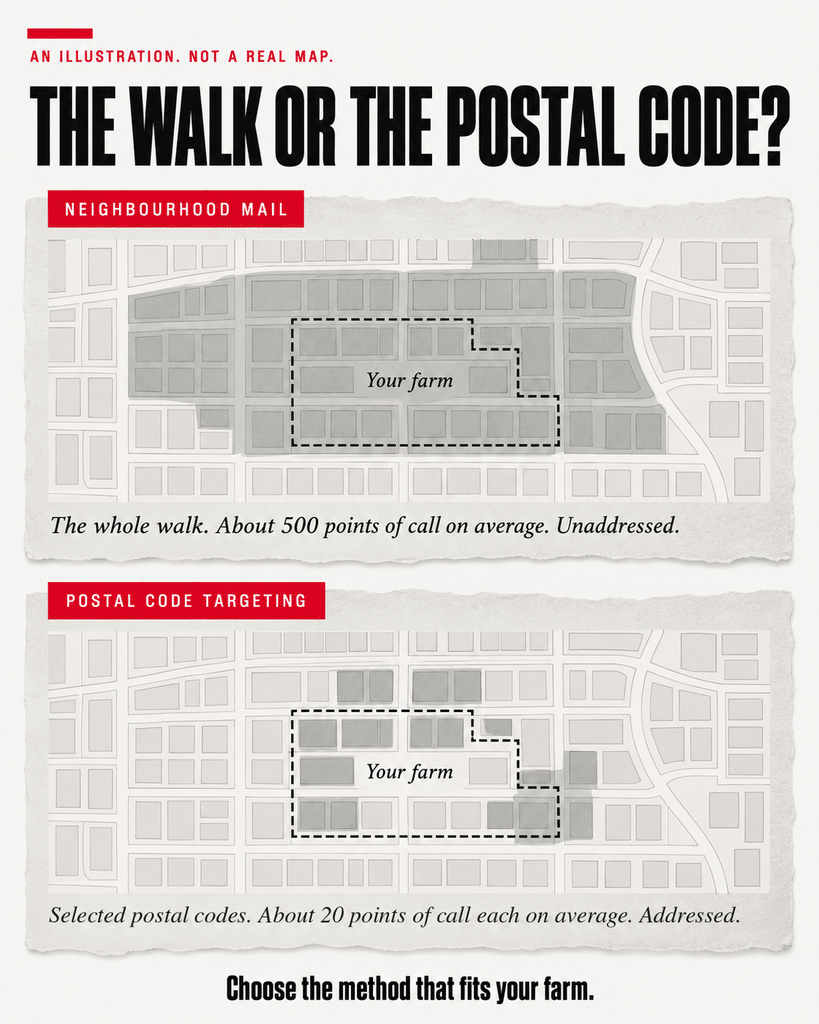
Neighbourhood Mail goes to the points of call on a postal walk, the route a letter carrier covers. There’s no name or address on the piece. You choose the walk, and the types of homes on it, such as houses or apartments. You don’t choose individual households.
Canada Post’s average walk is about 500 points of call, but walk sizes vary. At Noralta, the Studio helps agents review the available walks and their household mix before choosing where to mail.
Households that have opted out of unaddressed advertising mail through Canada Post’s Consumers’ Choice program won’t receive it.
Neighbourhood Mail is a natural fit for steady awareness across an area, and for Just Listed and Just Sold postcards around a listing.
Postal Code Targeting: the closer cut
Postal Code Targeting works postal code by postal code. A single postal code averages about 20 points of call. Sometimes that’s one side of a street. Sometimes it’s a single condo building, which makes it worth a look for condo farming. A campaign can include multiple selected postal codes, so the mailing area can extend beyond a single postal code.
Each piece carries a unique printed barcode. During processing, Canada Post reads the barcode and applies the delivery address. The mail service provider works with Canada Post’s encoded delivery data rather than receiving the actual address list.
Because it’s addressed mail, three things change.
- You can leave some people out. Postal Code Targeting supports existing-customer suppression, provided the addresses can be matched.
- Pricing works differently. Postage per piece is higher for addressed mail, but a tighter campaign may mean fewer pieces. Compare current quotes before you decide.
- Your design needs room. The addressing takes up space, which matters on smaller postcards. Plan for it before the artwork is final.
When the walk and the farm don’t line up
This is where the strategy from my post on choosing a farm meets the map.
Say your analysis points to a pocket of townhomes, because that’s the housing your ideal client wants. The postal walk that covers those townhomes also covers several streets of detached homes on the other side.
Now you have a real choice. Mail the whole walk and accept a broader audience. Or move to Postal Code Targeting and stay closer to the pocket your analysis picked.
The reverse happens too. If your farm already sits neatly inside a walk, Neighbourhood Mail can be exactly right. Paying for precision you don’t need doesn’t make a campaign smarter.
Neither choice is automatically better. The question is whether the execution still matches the strategy that got you there.
Leave out the people who already know you
Suppose some homeowners in your farm already receive your personalized Noralta newsletter, the database program from my last post.
You might not need to send them the same introductory postcard you’re sending to households that don’t know you yet.
Postal Code Targeting supports existing-customer suppression, provided the addresses can be matched. That gives you another option when you plan the audience. Neighbourhood Mail doesn’t offer household-level exclusion.
One more note. Consumers’ Choice doesn’t apply to addressed mail, but that isn’t a way around anyone’s wishes. If someone asks you to stop sending them marketing, stop.
Where Noralta helps make the decision
At Noralta, this is where the Agent Success Studio and our PostNow partnership help connect the strategy to the mailing options.
For Neighbourhood Mail, the Studio looks at Canada Post delivery walks and uses demographic information to favour routes with more homeowners. That narrows the audience, but it can’t remove every renter or pick individual households. We’re choosing the best available routes.
If a campaign needs a tighter area or an existing-customer suppression list, Postal Code Targeting may be worth considering. Those campaigns are arranged directly through PostNow.
Our Paragon Farming & Mailer Copilot guides agents through Canada Post’s Precision Targeter, the tool for choosing Neighbourhood Mail walks, and the steps around it. It doesn’t select recipients, place orders or send mail. Anyone can preview what it does, but the tool itself is only open to Noralta agents.
How to choose
Neighbourhood Mail tends to fit when:
- You want broad awareness across an area
- The postal walk lines up reasonably well with your farm
- The message applies to the whole area, not one pocket of it
- It’s a Just Listed or Just Sold postcard around a specific listing
Postal Code Targeting tends to fit when:
- Your farm is a narrower pocket, not a whole walk
- Specific streets or a single building matter to the strategy
- You want to leave out existing-customer addresses
- No available walk matches your farm closely enough
The same thinking applies in Edmonton, Sherwood Park, Spruce Grove and Fort Saskatchewan. The walks and postal codes change. The question doesn’t.
The question to ask before the mail goes out
Does the audience I’m about to mail still match the geography my strategy identified, or is it a convenient approximation of it?
If it matches, either method can work well. If the honest answer is “it’s close, but not quite,” sort that out before the campaign goes out, not after the pieces are in the mail.
Where to go from here
If you’re already mailing a farm, pull up the area you originally chose and compare it with the homes your campaign reaches. Same, close or different, you’ll want to know.
In geographic farming, choosing a farm is one decision. Choosing how to reach it is another. What matters is knowing why you made each choice, and making sure the next one still supports the last.
We started this part of the series by asking who you want to serve. We followed that person into the neighbourhoods, the sales data, the housing stock and, eventually, the mailbox.
Reaching more doors is easy. A good farming strategy has a reason for each door it chooses.
Frequently Asked Questions
What’s the difference between Neighbourhood Mail and Postal Code Targeting?
Neighbourhood Mail is unaddressed and reaches the points of call on the Canada Post walks you choose, about 500 per walk on average. Postal Code Targeting is addressed through a printed barcode and works by postal code, about 20 points of call each on average, with the option to leave out existing-customer addresses that can be matched.
Is Postal Code Targeting always better because it’s more precise?
No. Precision only helps when the strategy calls for it. Broad awareness across an area is a legitimate goal, and Neighbourhood Mail is built for it.
Which is better for real estate farming?
It depends on how closely your farm matches an available postal walk. When the farm and a walk line up well, Neighbourhood Mail fits. When the farm is a narrower pocket, or specific streets or buildings matter, Postal Code Targeting keeps the campaign closer to the strategy.
Can a farm area cross mailing boundaries?
Yes. A farm doesn’t have to match one postal walk or postal code exactly. That’s why it’s worth comparing your farm with the available mailing options before you choose a method.
Does Consumers’ Choice affect real estate postcards?
It can. Canada Post’s Consumers’ Choice program lets households opt out of unaddressed advertising mail, which includes Neighbourhood Mail. It doesn’t apply to addressed mail such as Postal Code Targeting. Either way, if someone asks you to stop sending them marketing, respect it.
Do I need consent under CASL to send farming postcards?
No. Canada Post notes that CASL doesn’t apply to physical mail. Real estate advertising rules and your brokerage’s requirements still apply, so confirm content with your broker before it goes out.