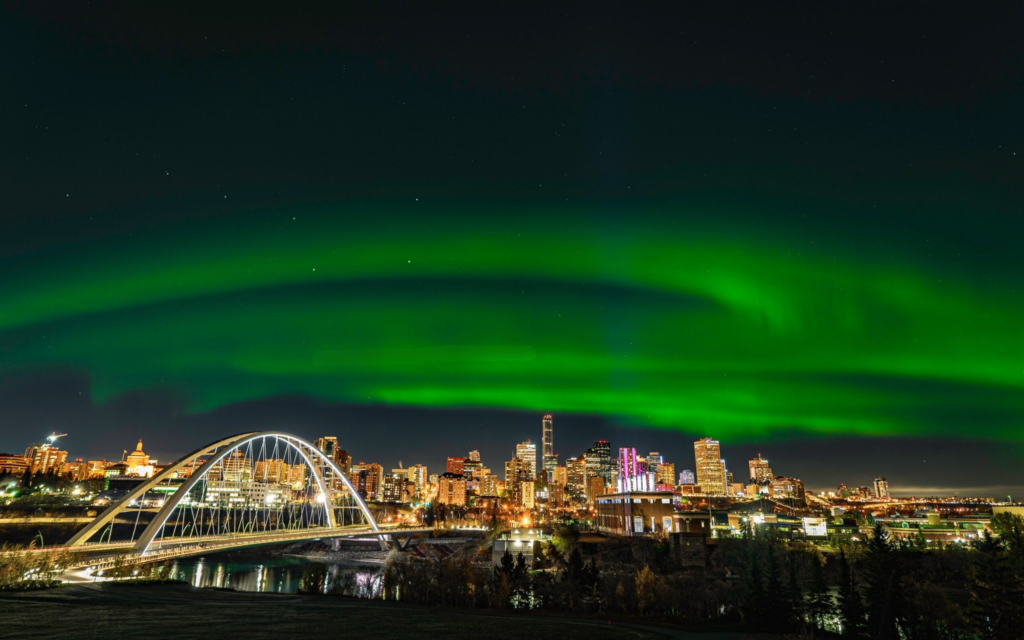
Downtown Edmonton Homes For Sale
Why Move To Downtown Edmonton
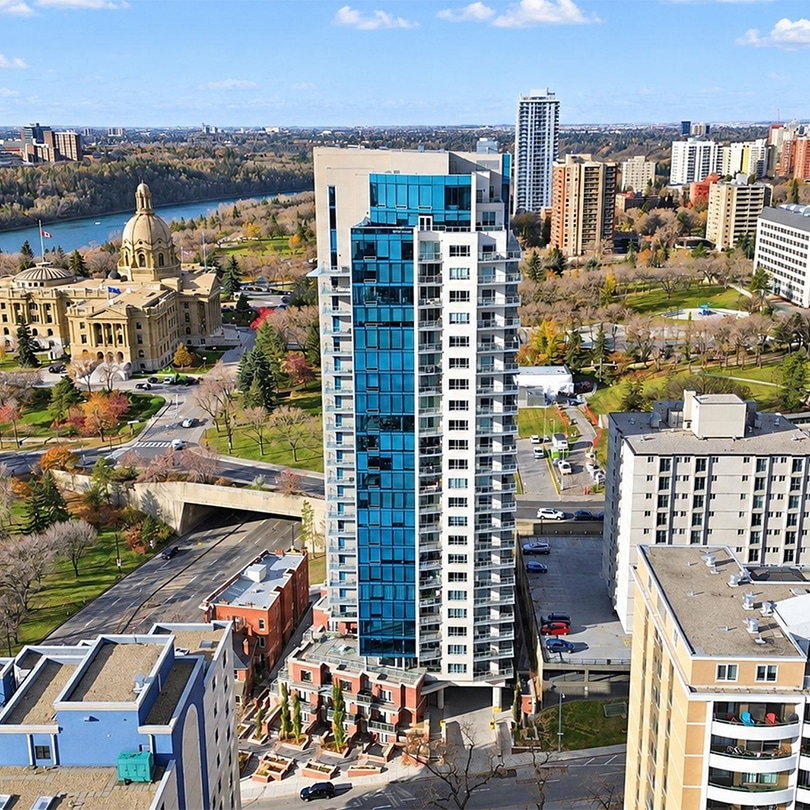
Downtown is one of Edmonton’s oldest areas and still its busiest. It sits where the North Saskatchewan River valley meets the financial and entertainment core, bounded roughly by 105 Avenue to the north, 97 Street to the east, 109 Street to the west, and the river valley to the south. The Legislature Grounds, MacEwan University, and the ICE District are all within a short walk of each other.
Many buyers here are making a straight trade: less space and no yard, in exchange for walking to almost everything. Rogers Place and the ICE District are on your doorstep. The Winspear Centre, Citadel Theatre, and Art Gallery of Alberta are a few blocks away in the Arts District. The river valley trail system is one elevator ride down, thanks to the 100 Street Funicular. That trade tends to appeal to people working in the core, students at MacEwan or NorQuest, and anyone downsizing out of a house they no longer want to shovel.
Much of Downtown’s housing was built in the last few decades, alongside older towers from the 1960s and 1970s. You can look at glass-and-steel high-rises with concierge service and heated parking, heritage loft conversions in the Warehouse District, or mid-rise condos throughout the core.
“Downtown is a different conversation. It’s mostly condos, so we start with what you’re buying it for: living in it or investing in it. Downtown has been the slowest part of the Edmonton market to recover since COVID, which is a risk but also the opportunity. Prices are well below where they were, and it’s the one property class that hasn’t rebounded yet. If you’re a buyer who understands the risks and has a long time horizon, there’s value in buying while it’s down.” Scott Tougas, REALTOR®
What Kind Of Homes Can You Find In Downtown Edmonton?
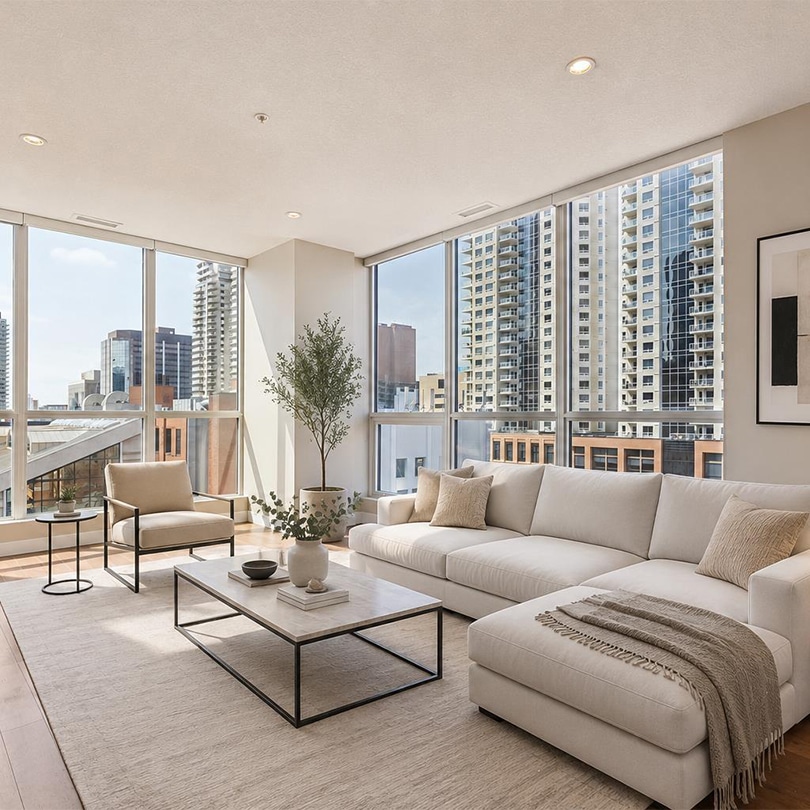
Detached houses barely exist in the core, so “homes for sale” Downtown means condos: high-rise towers, mid-rise apartment buildings, and a small pocket of heritage lofts.
The building matters as much as the unit here. Concierge service, heated underground parking, a well-used fitness room, and pedway access to the ICE District or the financial core are often what separates two similar floor plans.
Most listings are one- and two-bedroom units somewhere between 500 and 1,200 square feet. Over the 12 months to September 2026, the average Downtown home sold was about 880 square feet (MLS® System data). Penthouse and sub-penthouse suites in the newest towers run well past that. Along 104 Street in the Warehouse District you’ll find loft conversions with exposed brick, high ceilings, and mezzanine bedrooms, which is the kind of character a new tower can’t reproduce.
Condo fees, reserve fund health, and building age vary a lot between the 1960s and 70s towers and the newer ICE District builds. Read the condo documents closely at every price point. Past that, you’ll see everything from renovated units in established buildings to brand-new construction, so there’s room to move on both budget and finish level.
“Go in with your eyes open. Condos here are not a great investment on their own, and I know owners with leased units that are at breakeven or a loss and can’t sell without losing $50,000 to $100,000. So I want to see the condo documents, the reserve fund, and the monthly fees before we write anything. This is a market where you shouldn’t feel rushed. There’s room to negotiate, and I’ll make sure the numbers work before you buy.” Scott Tougas, REALTOR®
The Latest Downtown Edmonton Homes For Sale
Make Your Move To Downtown Edmonton With The Royal LePage Noralta Real Estate Team!
Neighbourhoods near Downtown Edmonton


Living In Downtown Edmonton: What to expect
Downtown is one of the most walkable areas in Edmonton, and one of the few where going car-free is realistic. Groceries, coffee, your gym, and your desk are usually within a few blocks, and the river valley is one elevator ride away.
What you give up is square footage. This is a condo market, not a house-and-yard one, and it suits some buyers far better than others.
“Downtown gets a bad rap lately, and it has struggled, but there are some great restaurants down here. Clients who live downtown love being able to walk to dinner, events and the river valley, which you can’t do in the suburbs. It’s a very different lifestyle.” Scott Tougas, REALTOR®
Shopping & Dining
Most of Downtown’s shopping and dining sits along Jasper Avenue, 104 Street, and Rice Howard Way. The ICE District adds sports bars, steakhouses, and event-night crowds around Rogers Place. The Downtown Farmers’ Market runs Saturdays on 104 Street from the May long weekend to Thanksgiving, alongside independent cafés and bakeries.
Grocery options vary by building, so check what’s within walking distance of the address you’re considering. Restaurants run from pizza and ramen to fine dining with a river valley view, and Churchill Square has something on the calendar most of the year.
Education
Downtown isn’t a typical family-with-kids market. The population skews toward young professionals, students, and downsizers. There are still good options for the families who do live here, and for post-secondary students the location is hard to beat.
Edmonton Public Schools:
- Victoria School of the Arts (K–12) at 10210 108 Avenue, just north of Downtown. An International Baccalaureate World School with a specialized arts program.
- Designated schools depend on your exact address and the school year. Check Edmonton Public Schools’ Find a School tool and Edmonton Catholic Schools’ school finder before you buy.
Post-secondary within walking distance or a short transit ride:
- MacEwan University, in Downtown
- NorQuest College, Downtown
- University of Alberta, a short LRT ride from Corona or Bay/Enterprise Square
- Northern Alberta Institute of Technology (NAIT), on the Metro Line
- The King’s University
- Concordia University of Edmonton
Transportation
Downtown is the hub of Edmonton’s transit network, which is a large part of the appeal for buyers who don’t want a car payment. The Capital Line and Metro Line run through the core, mostly underground, with stations at Churchill, Bay/Enterprise Square, Central, Corona, Government Centre, and MacEwan. The Valley Line runs southeast from Churchill and the Quarters, crossing the Tawatinâ Bridge toward the Muttart Conservatory, Bonnie Doon and Mill Woods.
The Edmonton Pedway connects many Downtown office towers, hotels, and LRT stations through enclosed bridges and tunnels, which makes a January commute considerably less unpleasant if your building is on the network. Dozens of ETS bus routes converge here. If you do drive, Jasper Avenue, 97 Street, and the Groat Road and Wellington Bridge corridor get you out to the rest of the city quickly.
“If you work downtown, the commute is basically gone. You’re walking, or you’re a short LRT ride away. If you’re commuting out, you’re right on the main routes, so access isn’t the issue.” Scott Tougas, REALTOR®
Recreation
Downtown residents can be in the river valley within minutes. The 100 Street Funicular, tucked behind the Fairmont Hotel Macdonald, drops you into Louise McKinney Riverfront Park in about a minute, and from there you’re on more than 160 kilometres of maintained river valley pathways. It’s flat and paved to the Tawatinâ Bridge, the Muttart Conservatory, and kilometres of trail in either direction.
Closer to home, Sir Winston Churchill Square is an outdoor rink in winter and a splash pad and festival ground in summer, hosting everything from the Edmonton International Street Performers Festival to New Year’s Eve. Rogers Place and the ICE District bring concerts, Oilers and Oil Kings games, and a casino. Many residential towers have a fitness centre, and some of the newest have full amenity floors.
Green Spaces
Downtown backs onto the North Saskatchewan River valley, Canada’s largest stretch of urban parkland. Louise McKinney Riverfront Park sits at the base of the funicular with open river frontage and a Chinese garden.
Inside the core, smaller parks like Alex Decoteau Park, Railtown Park, and Constable Ezio Faraone Park are tucked between condo towers and office buildings. They’re modest in size, but they put grass and mature trees within a short walk of almost any Downtown address.
Common FAQs About Living In Downtown Edmonton
In the 12 months to September 2026, Downtown homes, which are almost all condos, took about two months to sell on average, according to MLS® System data from the REALTORS® Association of Edmonton. The building, the unit, the condo fees and the reserve fund all affect how quickly a particular suite sells. One of our agents can show you what that means for yours.
In the 12 months to September 2026, the median sold price for a Downtown home was about $200,000, and the average home sold was about 880 square feet, based on MLS® System data. Prices vary widely from building to building, so ask one of our agents for recent sales in your building and nearby, or book a free home evaluation.
Downtown Edmonton is generally bounded by 105 Avenue to the north, 97 Street to the east, 109 Street to the west (111 Street north of Jasper Avenue), and the North Saskatchewan River valley to the south. Surrounding neighbourhoods include Wîhkwêntôwin (Oliver) to the west, Queen Mary Park, Central McDougall, and McCauley to the north, Boyle Street and Riverdale to the east, and Rossdale to the south.
Downtown isn’t subdivided into separate communities the way some areas are, but a few pockets stand out. The ICE District, anchored by Rogers Place, has the highest concentration of new-build luxury towers and the most amenities right at the door. The Warehouse District along 104 Street offers the most character, with heritage loft conversions in former industrial buildings. Riverside addresses along Bellamy Hill and 99 Avenue back onto the river valley and offer the closest thing to a natural outlook within the core.
Downtown is Edmonton’s most concentrated condo and apartment market, so it tends to move with the broader Edmonton apartment-condo segment rather than the detached-home market. Over the 12 months to September 2026, Downtown homes, which are almost all condos, took about two months to sell on average and sold for about 95% of their asking price (MLS® System data). That’s a slower pace than Edmonton’s suburban detached market, which generally gives buyers more time and room to negotiate. Well-priced units in well-managed buildings still draw buyers first. Building quality, condo fees, and reserve fund health matter a great deal here, so it helps to work with an agent who knows the individual towers.
Downtown offers a combination few Edmonton neighbourhoods match: a car-optional lifestyle, direct river valley access via the 100 Street Funicular, walkable arts and entertainment at your door, and the shortest possible commute to the financial core, MacEwan University, or NorQuest College. It’s the neighbourhood built for people who want city energy over yard space.
For the right buyer, yes. Downtown is one of the most walkable areas in Edmonton, and it suits people who value that lifestyle: skyline views, festivals at Churchill Square and quick access to the river valley. It’s a better fit for professionals, students, and downsizers than for families wanting a yard, but within that lens it’s hard to beat for convenience.
Book a free home evaluation with our team, or call us directly at 780-431-5600 to schedule an in-person consultation. We’ll go through recent sales in your building, what else is currently listed, and what Downtown buyers are paying for right now.
If you’re buying your first home, we can walk you through programs and options that may apply, such as the First Home Savings Account (FHSA), the Home Buyers’ Plan (HBP), the first-time home buyers’ tax credit and insured mortgages, subject to eligibility. We can guide you from pre-approval to keys in hand, connect you with mortgage specialists, and our Edmonton First-Time Home Buyer Guide has the full details.