


St. Albert Homes For Sale


Why Move To St. Albert
St. Albert is Alberta’s oldest non-fortified community and one of its larger cities. Father Albert Lacombe established the mission settlement here in 1861 to serve Cree and Métis families, it became the largest agricultural settlement west of Winnipeg, and it reached city status in 1977. That lineage still shows in the Perron District street grid and at the Father Lacombe Chapel.
Many buyers here are making a trade: a higher property tax rate than Edmonton, in exchange for larger lots, an established trail and recreation network, and a short drive into north Edmonton. What that buys is nearly 100 kilometres of trail in the Red Willow Trail system along the Sturgeon River, Servus Credit Union Place, and a choice of public and Catholic school divisions.
That trade tends to appeal to families trading up out of Edmonton, buyers who want a detached home on a full lot without going rural, and downsizers who want to stay in the city they raised kids in. Maclean’s ranked St. Albert the top community in Alberta in 2019, and 23rd in Canada. The honest counterweight is the commute: if you work downtown and drive daily, sit in St. Albert Trail traffic at 8 a.m. before you commit.
St. Albert Real Estate Statistics
What do homes cost in St. Albert right now?
In the 12 months to September 2026, the median sold price in St. Albert was about $520,000, across nearly 1,400 residential sales (MLS® System data). Prices cover a wide range, from condominium apartments at the entry level to estate homes on large lots. For current listing prices and counts, see the live statistics on this page.
That spread is wider than it looks, because St. Albert has been building continuously since the 1960s. A 1,100 square foot bungalow in an established neighbourhood and a 2,400 square foot new build in Erin Ridge North are both St. Albert, and they are not close to the same purchase. As a rule, newer construction and larger lots cost more, and established neighbourhoods with older homes are where buyers usually find more room in the budget.
“St. Albert has been the most competitive market in the Greater Edmonton Area since COVID. If you love a house, be ready to compete and be comfortable going over list, because you often get one shot at it. There’s usually a line of buyers waiting, whether they’re upsizing, downsizing, or coming from Edmonton or Spruce Grove and Stony Plain.” Scott Tougas, REALTOR®
What types of homes are for sale in St. Albert?
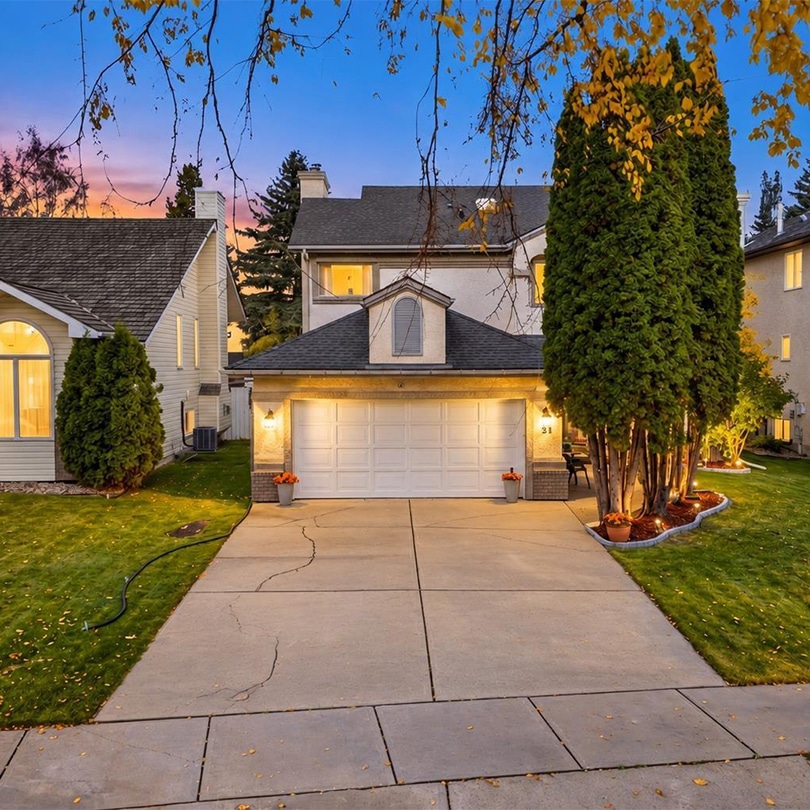
St. Albert has been building continuously since the 1960s, so “homes for sale” here covers a wide range: 1970s bungalows on oversized lots, two-storey family homes through the 1990s and 2000s, new builds in the north end, and an estate market at the top end.
Condominium apartments are the entry point to the city, and a common first purchase for buyers moving out of rentals. Townhouses and duplexes sit above that, in both newer and established neighbourhoods.
Bungalows are St. Albert’s signature housing type in the older neighbourhoods, typically 1,000 to 1,400 square feet often on generous lots. Many buyers choose them for the lot as much as the house. Two-storey family homes make up much of what sells, with prices that vary by age, neighbourhood and size.
Lot size is the thing to pay attention to at every price point, because it varies so much from one neighbourhood to the next. Past that you’ll see everything from original-condition 1970s homes to brand-new construction, so there’s room to move on both budget and finish level.
The Latest St. Albert Homes For Sale
Book Showings for Your Favourite Houses for Sale in St. Albert Today!
St. Albert Neighbourhood
If you want an established neighbourhood with mature trees: Akinsdale, Forest Lawn, Braeside and Sturgeon Heights. Mostly 1970s construction, mature trees, larger lots, housing stock that often needs updating.
If you want newer construction: Jensen Lakes, Erin Ridge North, Riverside and Cherot carry the most recent builds.
If you want to walk somewhere: Downtown St. Albert, Mission and Grandin put you closest to the Perron District, St. Albert Place and the Sturgeon River trail system.
If you are buying for the lot: Woodlands, Heritage Lakes, Deer Ridge, Inglewood, Pineview and Lacombe Park sit closest to the ravine and lake systems.
“I’m an established-neighbourhood-first guy in St. Albert, and really anywhere. You get an instant community: mature trees, developed parks, proven infrastructure, and almost always a better location. I focus most of my clients on Grandin, Braeside, Lacombe Park, Pineview, Woodlands and Kingswood. We can find a home that fits your needs in any of them, and you’re closer to everything than you would be in the newer developments further out, which tend to feel pretty cookie-cutter.” Scott Tougas, REALTOR®
Living In St. Albert: What to expect
St. Albert runs on its river valley and its recreation calendar. The Sturgeon River cuts through the middle of the city, the Red Willow Trail system follows it end to end, and most of what residents do outside happens along that spine.
What you give up is proximity. This is a commuter city for anyone working in central Edmonton, and the winter drive is a real consideration.
“It’s a family-oriented community right outside Edmonton with a small-town feel. People call it ‘The Bubble’ for a reason. Clients tell me they feel comfortable in every neighbourhood, the schools are well regarded, and the parks and amenities are great. It’s a good place to raise a family.” Scott Tougas, REALTOR®
Shopping & Dining
St. Albert Centre anchors the big-box and chain retail along St. Albert Trail. The Perron District in Downtown St. Albert runs the other direction: small, independent and locally owned, with nearly 50 shops, galleries, cafés and restaurants.
The St. Albert Farmers’ Market is Western Canada’s largest outdoor market, with about 270 vendors on Saturdays from mid-June to early October. The Enjoy Centre combines a greenhouse and garden centre with event space, an organic restaurant and a health food store. For restaurants, JACK’s Burger Shack, Glasshouse Kitchen | Bar, The Cajun House and Nello’s are the local staples.
Education
St. Albert has two school divisions: St. Albert Public Schools and Greater St. Albert Catholic Schools.
St. Albert Public Schools:
- Paul Kane High School and Bellerose Composite High School (Grades 10–12)
- William D. Cuts and Lorne Akins Junior High Schools (Grades 7–9)
- Elmer S. Gish School, which runs the Cogito program (K–9) alongside the regular English stream (K–6)
- Elementary schools including Muriel Martin, Ronald Harvey, Leo Nickerson, Wild Rose, Lois E. Hole and Sir Alexander Mackenzie, plus Joseph M. Demko School (K–9) and Hillgrove School (Grades 5–9)
Greater St. Albert Catholic Schools:
- École Secondaire St. Albert Catholic High School (Grades 10–12, English and French Immersion), plus St. Gabriel Education Centre (Grades 9–12)
- École Secondaire Sainte Marguerite d’Youville, Vincent J. Maloney and Richard S. Fowler Catholic junior highs (Grades 7–9)
- Elementary schools including Albert Lacombe, Bertha Kennedy, École Father Jan, École Marie Poburan, Holy Family, J.J. Nearing and Neil M. Ross, plus Sister Alphonse Academy (K–9)
Both divisions offer French Immersion. Families targeting a specialty program should confirm boundaries before writing an offer, because program access is school-specific rather than district-wide.
Post-secondary within a 30-minute drive, all in Edmonton:
- University of Alberta
- MacEwan University
- Northern Alberta Institute of Technology (NAIT)
- NorQuest College
- Concordia University of Edmonton
- The King’s University
Transportation
St. Albert is about 15 kilometres from downtown Edmonton, a drive of roughly 15 minutes off-peak and considerably longer in winter rush hour. St. Albert Trail is the main artery south and Anthony Henday Drive connects the city to the rest of the region without routing through it.
St. Albert Transit (StAT) runs local service and commuter routes into Edmonton, including to the University of Alberta, MacEwan University, downtown, West Edmonton Mall and NAIT, with an LRT connection at Kingsway. For cyclists, the Red Willow Trail system runs the length of the Sturgeon River through the middle of the city. For anything beyond the city core, most people drive.
“Stay on the south side of St. Albert. Whether it’s Grandin, Heritage Lakes, Akinsdale, Pineview, Woodlands or Kingswood, you’re only minutes from the Henday, and you can reach most of Edmonton in about 30 minutes. For commuters, that’s the easiest access in the city.” Scott Tougas, REALTOR®
Recreation
Servus Credit Union Place is the city’s main recreation complex, with pools, arenas, fitness facilities and programming across all ages. Fountain Park Recreation Centre adds a second pool and fitness space. St. Albert has active minor hockey and football programs.
On the cultural side, the Arden Theatre programs touring music and theatre year-round, and the Father Lacombe Chapel is a Provincial Heritage Site and, according to the City, the oldest building in Alberta. The International Children’s Festival of the Arts runs each year in late May or early June.
Green Spaces
St. Albert maintains 99.5 kilometres of trails through parks, nature reserves and riverfront, most of it connected along the Sturgeon River via the Red Willow Trail system. Residents use it for walking, cycling, running and in-line skating.
Lois Hole Centennial Provincial Park sits on the city’s western edge at Big Lake, one of the more significant bird habitats in the Edmonton region. The St. Albert Botanic Park operates as a public garden and is open to everyone.
Common FAQs About Living In St. Albert
In the 12 months to September 2026, St. Albert homes sold in about a month on average, according to MLS® System data from the REALTORS® Association of Edmonton. A move-in-ready family home and an original-condition bungalow can sell on very different timelines, so one of our agents can show you what that means for your home.
In the 12 months to September 2026, St. Albert recorded nearly 1,400 residential sales, with a median sold price of about $520,000 (MLS® System data). Prices vary widely by neighbourhood and home type, so ask one of our agents for recent sales near you, or book a free home evaluation.
In the 12 months to September 2026, the average sold price for a St. Albert home was about $535,000, and the median was about $520,000 (MLS® System data). For current listing prices, see the live statistics on this page. Condominium apartments are the most affordable way into St. Albert, and detached homes on full lots make up much of what sells. The spread is wide because St. Albert has been building continuously since the 1960s, so a 1970s bungalow and a new build in the north end are both St. Albert and are not close to the same purchase.
Over the 12 months to September 2026, St. Albert homes sold in about a month on average and at close to full asking price (MLS® System data). In September 2026, sales were down from a year earlier and homes took longer to sell, while prices held steady. Check the live statistics on this page, read our latest market update, or ask one of our agents for a current read on your part of St. Albert.
St. Albert’s housing stock covers condominium apartments, townhouses and duplexes, 1970s bungalows on oversized lots, two-storey family homes, new builds in the north end, and estate properties at the top end. Detached homes on full lots are the bulk of what trades, which is the main structural difference between St. Albert and comparable inner-Edmonton neighbourhoods.
Over the 12 months to September 2026, Grandin, Lacombe Park, Akinsdale, Erin Ridge North and Riverside had the most residential sales in St. Albert (MLS® System data). Grandin and Akinsdale offer some of the city’s more affordable options, while Erin Ridge North, Riverside and Jensen Lakes are where much of the new construction sells. Families who want established homes and mature trees also look at Braeside, Forest Lawn and Sturgeon Heights. Our agents can walk you through the trade-offs.
Buyers moving to St. Albert from Edmonton are paying a premium for lot size, school access and a shorter list of things to worry about, and it’s a trade our agents talk through with clients heading north. St. Albert’s residential property tax rate has been among the highest in Alberta.
What the premium buys is measurable. The city maintains 99.5 kilometres of trail, Servus Credit Union Place is one of the larger municipal recreation complexes in the Edmonton region, and St. Albert was ranked the best community to live in Alberta by Maclean’s in 2019.
The history is part of the appeal and it is real. Father Albert Lacombe established the St. Albert mission settlement in 1861, making it Alberta’s oldest non-fortified community. It was once the largest agricultural settlement west of Winnipeg, and it became a city in 1977. That lineage shows up in the Perron District street grid and in the Father Lacombe Chapel, which still stands as the oldest building in Alberta.