
Updated: September 2026 · Last verified: 09/01/2026
If you’re considering changing real estate brokerages in Edmonton, one of the first things you’re probably going to compare is the pay plan.
I understand why.
When agents call me about changing brokerages, I tend to hear from two different groups.
The first are established, independent agents who want to get right to the bottom line. They want to compare fees and determine which brokerage offers the best deal. Often something has prompted the search: their brokerage is changing, fees have increased, or they simply don’t enjoy the environment anymore.
The second group is looking for something different. They’re trying to start or restart their business. Maybe their real estate career hasn’t taken off the way they hoped. Maybe they’ve reached a plateau. They aren’t simply looking for somewhere new to hang their licence. They’re looking for an environment where they can grow.
Both have legitimate reasons for considering a move.
But after more than 25 years in real estate, I’ve come to think there’s a more important question to ask before comparing commission splits:
What kind of real estate career are you actually trying to build?
The cheapest brokerage isn’t necessarily the least expensive
Commission splits and brokerage fees matter. If two brokerages provide everything you need to run your business equally well, paying less is an easy decision.
But that’s rarely the whole comparison. A better question might be:

What would have to happen in my business for the additional cost of this brokerage to be worthwhile?
Could better training help you convert an opportunity you might otherwise lose? Could stronger marketing help you win another listing? Could better systems keep an opportunity from falling through the cracks? Could a collaborative peer group create referrals or ideas that lead to business? Could responsive support give you the confidence to pursue opportunities you might otherwise avoid?
A brokerage doesn’t create your success for you, and paying more certainly doesn’t guarantee you’ll sell more homes. But if the environment, support and resources around you help you create even a few additional transactions over the course of a year, the cheapest brokerage may not produce the best financial result.
The opposite is also true. If you’re an established agent with your own systems, marketing, support network and consistent source of business, and you aren’t going to use additional brokerage resources, paying for them may not make sense.
So don’t just ask: “What does this brokerage cost?”
Ask: “What return am I likely to get from what I invest in my brokerage?”
Start with the agent you want to become
I think brokerage fit goes deeper than services. One of the most important questions an agent can ask is:
Will this environment help me become a more authentic version of myself as a real estate professional?
There isn’t one personality type that succeeds in real estate. Some agents are exceptional networkers. Others build deep relationships with a smaller group of clients. Some love prospecting. Some are natural educators. Some build their businesses around neighbourhoods. Others thrive through digital marketing, video or a specialized area of practice.
Trying to force all of those people into the same sales system doesn’t make much sense.
A good brokerage environment should help you discover a sales style that fits your personality, strengths and goals, while still helping you develop the skills and disciplines required to become a professional.
And there’s another part of fit that’s easy to underestimate: the people around you. I believe agents benefit from being part of a network of collaborative professionals who want to succeed themselves while also continually improving at what they do.
Independence and collaboration aren’t opposites. The right environment should help you develop both.
Sometimes an agent doesn’t need more pressure. They need the brakes released.

I’ve seen what can happen when there’s a mismatch between what an agent needs and what their brokerage provides.
One newer agent I met had been mentored by a Broker who was also an active selling agent. The Broker had good real estate knowledge and initially took a genuine interest in helping. But new agents often need more depth, repetition and patience than expected. Over time, the Broker became more difficult to approach and less available when the agent needed help.
When the agent came to us, we didn’t start with an elaborate lead-generation strategy. We went back to the basics. We worked on confidence around transactions, the business itself and meeting new clients. We helped provide a couple of early opportunities and encouraged the agent to experiment with creating video content.
That agent went from completing one transaction in their first year to ten so far this year.
The interesting part to me isn’t the number. It’s what happened before the number changed. Their confidence changed.
I’ve seen something similar with an agent who came from a lower-cost environment primarily structured around high-producing teams. The team leader they were working with wasn’t able to consistently provide the leads the agent had expected and had limited patience for helping them develop an independent practice.
This agent needed something different: resources they could lean into while building their own business, peers willing to collaborate and exchange ideas, and access to a responsive Broker who wasn’t focused exclusively on top performers.
In the right environment, the agent began developing an independent, growth-oriented practice while still having a peer group around them. Their production began outperforming their previous practice. It was almost like the brakes were released.
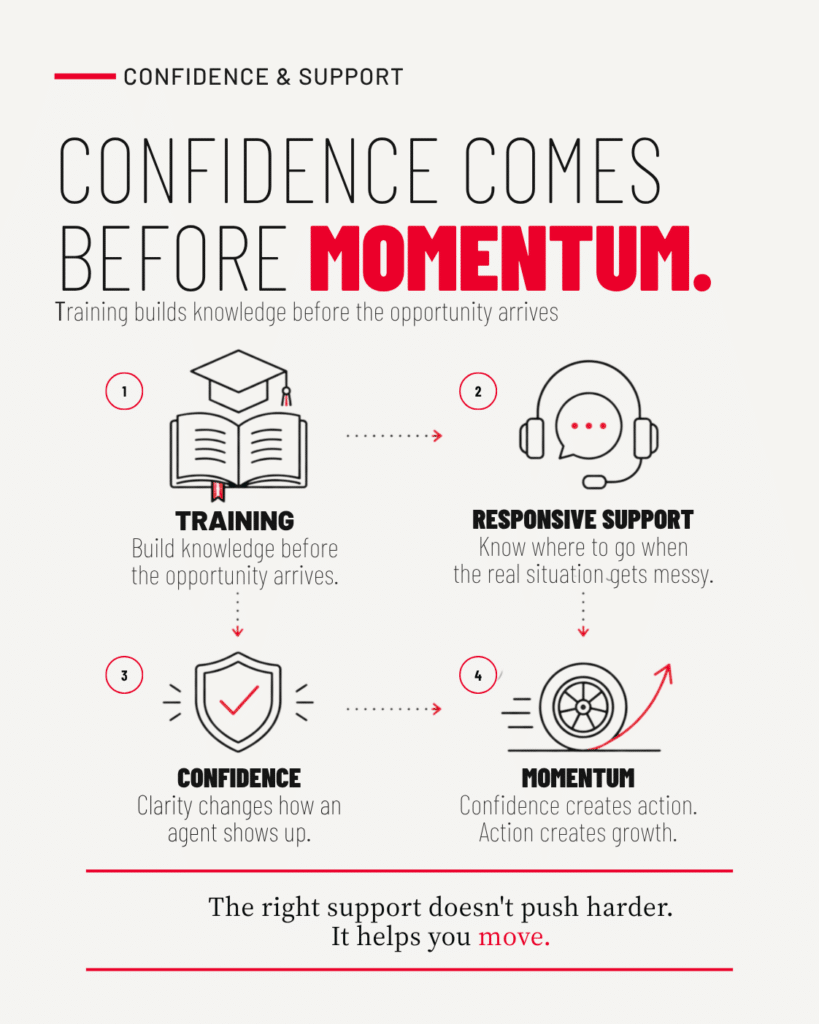
Confidence comes before momentum
I’ve come to believe one of the first things a good brokerage environment can help an agent acquire isn’t a lead. It’s confidence.
A real estate career presents a constant stream of moments where you’re expected to know what to do: your first listing presentation, a difficult negotiation, an unusual condition, an inspection problem, an unhappy client or a transaction where something simply doesn’t look right.
An agent who spends those moments worrying about making a mistake approaches opportunity differently from an agent who knows there are experienced people behind them.
That’s where training and responsive support can work together. Training builds knowledge before the opportunity arrives. Support helps when reality doesn’t look exactly like the example from the training room.
Together, they can move an agent from “I hope I don’t mess this up” toward “I know how to handle this, and I know where to go if I need help.”
Confidence makes it easier to pursue opportunity. Opportunity creates experience. Experience creates momentum. Then you can build the systems and habits that turn activity into a professional business.
What does brokerage support actually mean?
Almost every brokerage says it provides support. So I’d encourage agents to dig deeper than the word itself.
Ask what support looks like on a Tuesday afternoon when you have a problem. Who answers the phone? Is there a clearly identified person responsible for helping you? Is that person responsive? Are they interested in helping you develop your business, or primarily there to answer compliance questions?
Look at the administration behind the brokerage too. Is the entire operation dependent on one key administrator, or is there depth to the team? What happens when someone is sick or away? How reliably are transactions processed? What help is available for the administrative pieces that consume an agent’s day?
Then ask what happens after orientation is over. How will this brokerage help you build a plan to grow your business?
A brokerage doesn’t need to do everything for an agent. Real estate professionals are independent businesspeople, and ultimately the responsibility for building the business belongs to the agent. But independence shouldn’t have to mean isolation.
Look beyond the local brokerage
There’s another part of the equation that’s easy to overlook: the larger network and brand behind the brokerage.
A strong network can provide professional content, technology, education, research, marketing resources and relationships with other real estate professionals that would be difficult for an individual agent to reproduce independently.
But the logo itself isn’t enough. Ask whether your local brokerage actually helps you take advantage of those resources. The best technology has little value if nobody helps you understand how it fits into your business. A library of marketing content isn’t particularly useful if you don’t know what to do with it. Training only matters if you can translate it into action.
The combination matters: brand + brokerage + people + systems + agent effort.
Three questions I’d ask before joining a brokerage
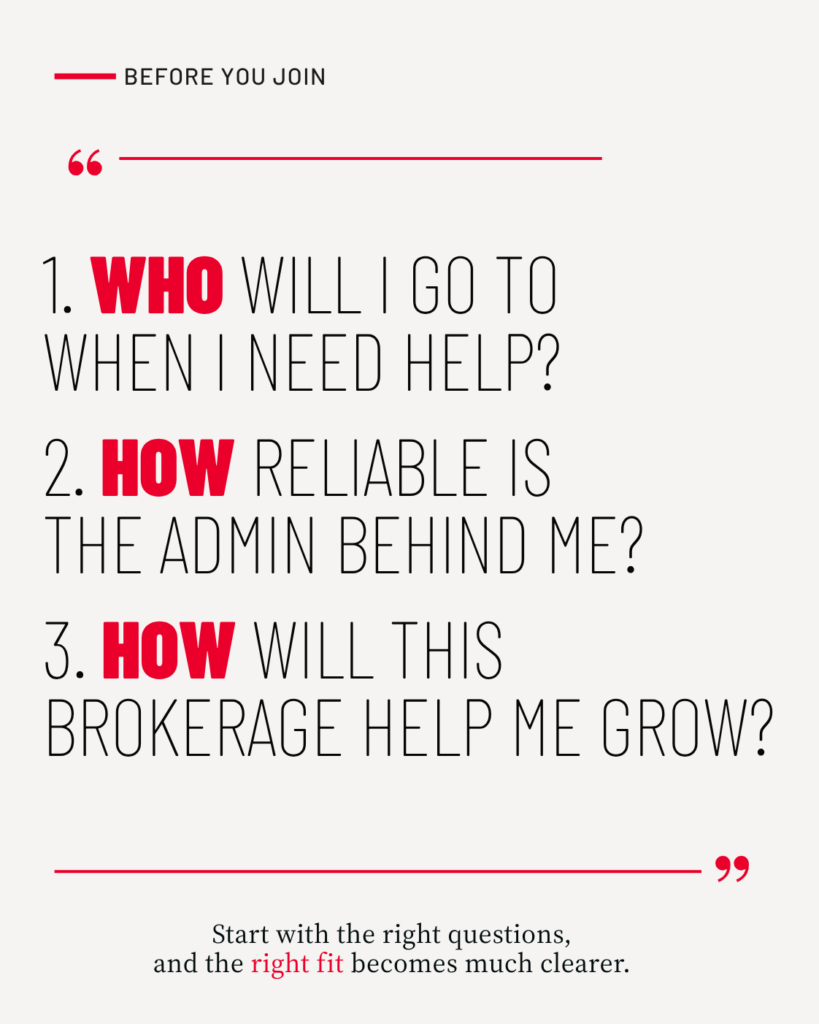
If an agent told me they were interviewing three Edmonton brokerages this week, I wouldn’t tell them to ignore the commission split. I’d tell them not to start there. I’d make sure I could answer these three questions first:
Who will I go to when I need help?
Find out who that person actually is. Meet them if possible. Decide whether you believe they’re responsive, knowledgeable and genuinely interested in helping you develop.
How reliable is the brokerage’s administrative infrastructure?
Understand who’s behind the scenes helping transactions move properly. Is the brokerage dependent on one person, or is there depth to the team?
How will this brokerage help me grow my business?
Ask for specifics. What happens after you join? What training, coaching, technology, systems, peer groups, marketing resources or business-development frameworks will actually be available to you?
Then look at the pay plan. Because now you know what you’re comparing.
The best brokerage is the one that fits the career you’re building
There isn’t one best real estate brokerage in Edmonton. There is a brokerage that’s better suited to you, your current stage and the business you’re trying to build.
For one agent, that may be a highly independent, low-cost model. Another may need intensive training and accessible mentorship. An established producer may need sophisticated administrative or marketing leverage. Someone else may need collaboration and accountability to get through a plateau. And what you need today may not be what you need five years from now.
That’s why I think choosing a brokerage should begin with understanding the life and career you’re trying to create, how you’re naturally suited to build relationships and business, and what kind of environment will help you do it.
Don’t just ask: “What will it cost me to work here?”
Ask: “Will this environment help me build the real estate career I actually want?”
The answer to that question may ultimately be worth considerably more than the difference between two pay plans.
Where to go from here
If you want a starting point for that conversation with yourself before you sit down with any brokerage, we built a Brokerage Alignment Quiz for exactly that reason, not to tell you Noralta is the answer, but to help you think through what you’re actually looking for.
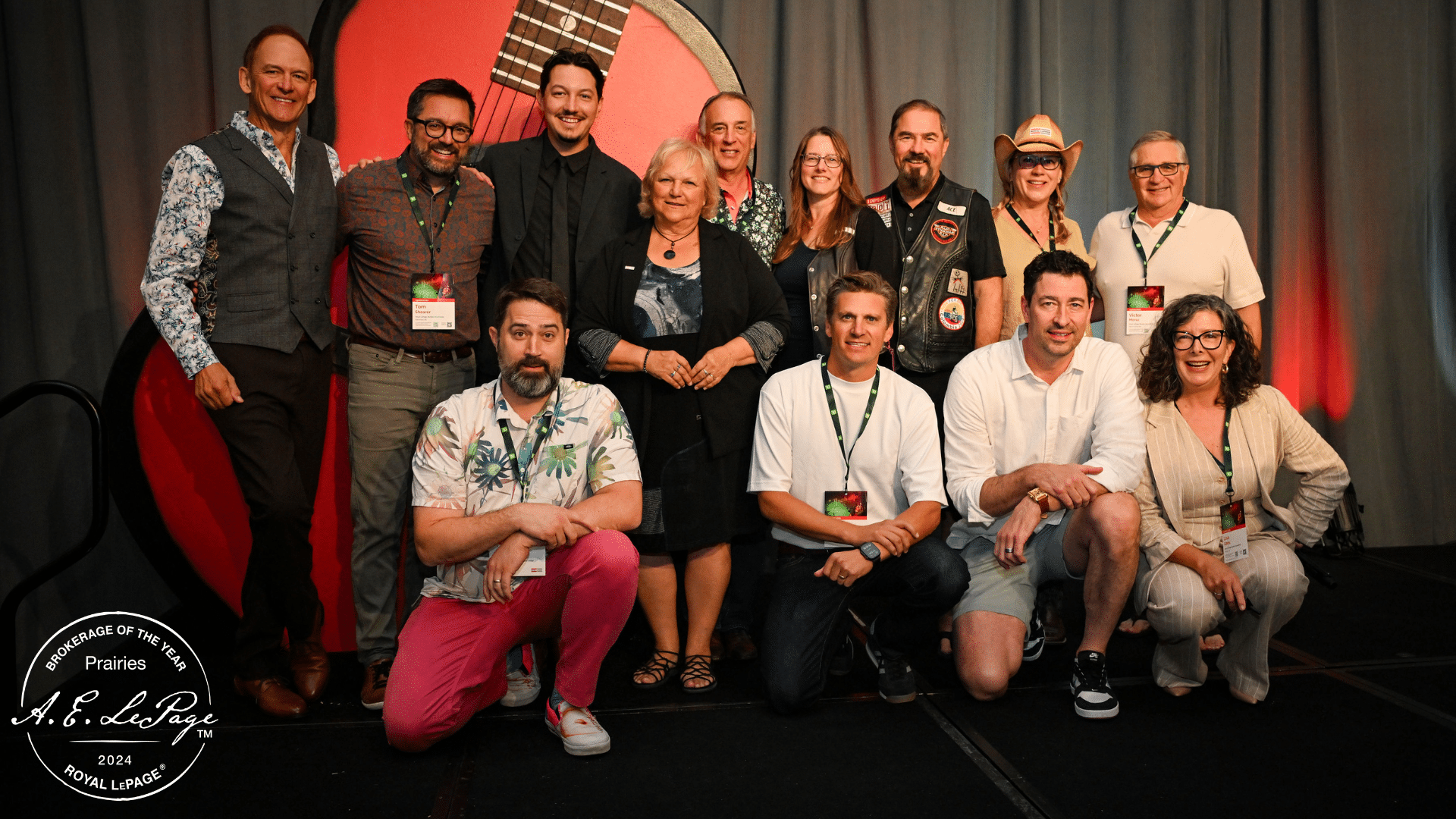
Royal LePage Noralta currently has 178 agents across four regional offices. In 2025, the brokerage recorded 2,322 sales, which works out to roughly 13.3 sales per agent at the brokerage level. That number won’t tell you what your career should look like. It tells you there’s real production happening here, which is a reasonable thing to know before you ask the three questions above of any brokerage, including this one.
Take the Brokerage Alignment Quiz, or if you’d rather just talk it through, reach out and we’ll have a conversation. No pressure, no pitch, just the same three questions I’d ask anyone.
Frequently Asked Questions
What should I look for when choosing a real estate brokerage in Edmonton?
Look beyond commission splits and monthly fees. Consider Broker accessibility, administrative support, training and coaching, business-development resources, technology, marketing support, the peer environment and whether the brokerage’s model fits the business you want to build.
Should a new REALTOR® choose the brokerage with the best commission split?
Not necessarily. Early in a career, training, mentorship, accessible support and opportunities to develop confidence may be more valuable than minimizing brokerage costs. Understand both what you’re paying and what you’d need to provide yourself.
Is a low-cost real estate brokerage a bad choice?
No. A lower-cost model can be an excellent fit for an established, highly independent agent who already has the systems and resources they need. The question is whether the model fits you.
Can changing brokerages help grow my real estate business?
A brokerage change won’t create growth by itself. Moving into an environment better aligned with your needs can provide training, support, collaboration and systems that help you pursue growth. The agent still has to do the work.
What questions should I ask when interviewing a real estate Broker?
Start by asking who will personally help you when you have a problem, how the brokerage’s administrative support works, and what specific resources are available to help you develop and execute a plan for your business.
Can I switch real estate brokerages in Alberta?
Licensed real estate professionals can change brokerages, but the process involves brokerage and licensing requirements. Agents considering a move should speak with the brokerages involved and review current RECA requirements before making changes.