
Updated: September 2026 · Last verified: September 29th, 2026 · Verification owner: Diana McGee
In the last piece in this series, I broke down what brokerage support can actually include. I organized it around three pillars: Agent Support, Agent Success, and Agent Development.
Underneath all three was one of my mantras as a broker: remove the friction from the agent’s work.
But there’s another side to that conversation.
How do you know whether the support around you is actually working?
I don’t think the answer is found on a recruiting brochure or by counting how many programs a brokerage offers. It’s probably better found in the small interactions you have with your brokerage when you’re actually trying to do the work.
I’m not here to complain about brokerages. I just have four questions I’d encourage any agent to ask about their own experience.
Question 1: When something gets complicated, do you know who to call?
Not “Is there a phone number somewhere?”
If something unusual happened in a transaction this afternoon, who would you call? Can you picture the person? Would you be comfortable calling them? And do you have confidence that they’re interested in helping you work through it?
I’ve seen how much difference that last part can make.
Agents don’t necessarily need the broker to have an immediate answer to every question. Sometimes the issue needs to be researched. Sometimes another person needs to be brought into the conversation. Sometimes the agent already knows the answer and really needs someone experienced to test their thinking against.
And sometimes there isn’t really a technical question at all. The agent knows what needs to happen. They’re just not confident about how to have the conversation.
We see this when an agent has to talk with a challenging client. Maybe they need to deliver difficult news, reset an expectation, explain why a strategy isn’t working, or have a conversation they’re worried could become confrontational.
In those situations, we’ll sometimes role-play the conversation. What are you going to say? How might the client respond? What happens if they push back? Is there a better way to frame the issue?
Nobody gets a script to read. They get a safe place to practise, so the real conversation feels a little more familiar when it comes.
Sometimes the most useful support is helping someone get confident enough to handle it themselves.
You shouldn’t have to wonder whether your question, or the conversation you’re worried about having, is important enough to call about.

Question 2: Have you stopped asking for help?
This one is probably harder to notice.
As agents become more experienced, they naturally need less help with some things. That’s a good thing. Independence and confidence should grow with experience.
But there’s a difference between not needing help and giving up on asking for it.
Think about the last year. Are there things you’re now figuring out on your own because you’ve developed the knowledge and experience to handle them? Or are you figuring them out on your own because, at some point, it became easier than asking?
It rarely happens all at once. A question sits unanswered, or the answer takes a few days, and the next time you just work it out yourself. After a while, not asking becomes the habit.
If you’ve stopped reaching for that support, it’s worth asking yourself why.
Question 3: Are you finding out about problems after they’re already problems?
Some problems in real estate are unavoidable. Deals get complicated. People disagree. Documents get missed. Regulations change. Something that looked straightforward on Monday can become considerably less straightforward by Friday.
Problems will happen. What matters is when the support around you starts working on them.
Does someone notice something unusual in a contract and ask about it? Do you get a reminder before something important is missed? Can you run a situation past someone before deciding how to handle it? Does your brokerage help you understand changes to the regulatory environment before you accidentally run into them?
Good brokerage support shouldn’t only show up in emergencies. A lot of its best work happens quietly in the background… a second set of eyes, a quick conversation, a simple question that keeps something small from turning into something big.
That’s part of removing the friction too.
Question 4: Are the people around you helping you get better?
Brokerage support isn’t only about what happens when you have a problem.
There’s another question worth asking: am I becoming better at this business because of the environment I’m working in?
I put a lot of work into our Monday Morning Meetings at Noralta. We talk about what’s happening in the market, changes in our industry, situations we’re seeing in transactions, prospecting ideas, client service, marketing, technology and sometimes very specific problems that have come across my desk.
I certainly don’t have all the answers. That’s actually part of what makes those meetings valuable.
Put a group of real estate professionals in a room and the depth of knowledge changes. Someone has handled that kind of transaction before. Someone tried the marketing idea. Someone knows the neighbourhood. Someone has found a better way to explain something to a seller. Someone asks a question that makes the rest of us think differently.
One person’s experience becomes something the whole room can use.
That’s one of the most overlooked benefits of a collaborative brokerage. You get your broker, your trainer and your support team. You also get the experience of every agent sitting around that table.
That doesn’t mean every agent needs to attend every meeting or participate in everything a brokerage offers. But it’s worth asking: does the environment I’m in expose me to ideas, people and conversations that make me better at what I do?
If the answer is yes, that’s real support too.

Great support usually isn’t a dramatic moment
When people think about broker support, they sometimes imagine the major crisis: a transaction is falling apart and the broker steps in with the perfect advice that saves the deal.
Those moments happen.
But in my experience, great support is usually much less dramatic. It’s steady, consistent, reliable and positive.
Someone answers the question. Someone says, “Yes, you can do this.” Someone role-plays a difficult client conversation with you before you make the call. Someone brings a situation into a Monday Morning Meeting and an entire room gets to learn from it. A door gets opened. An idea gets shared. Someone else’s experience saves you from having to learn every lesson the hard way.
Individually, those moments can seem small. Over time, they build two things I think are incredibly valuable in this business: confidence and collective knowledge.
Confidence changes the way an agent approaches opportunity. Collective knowledge means none of us has to figure everything out alone.
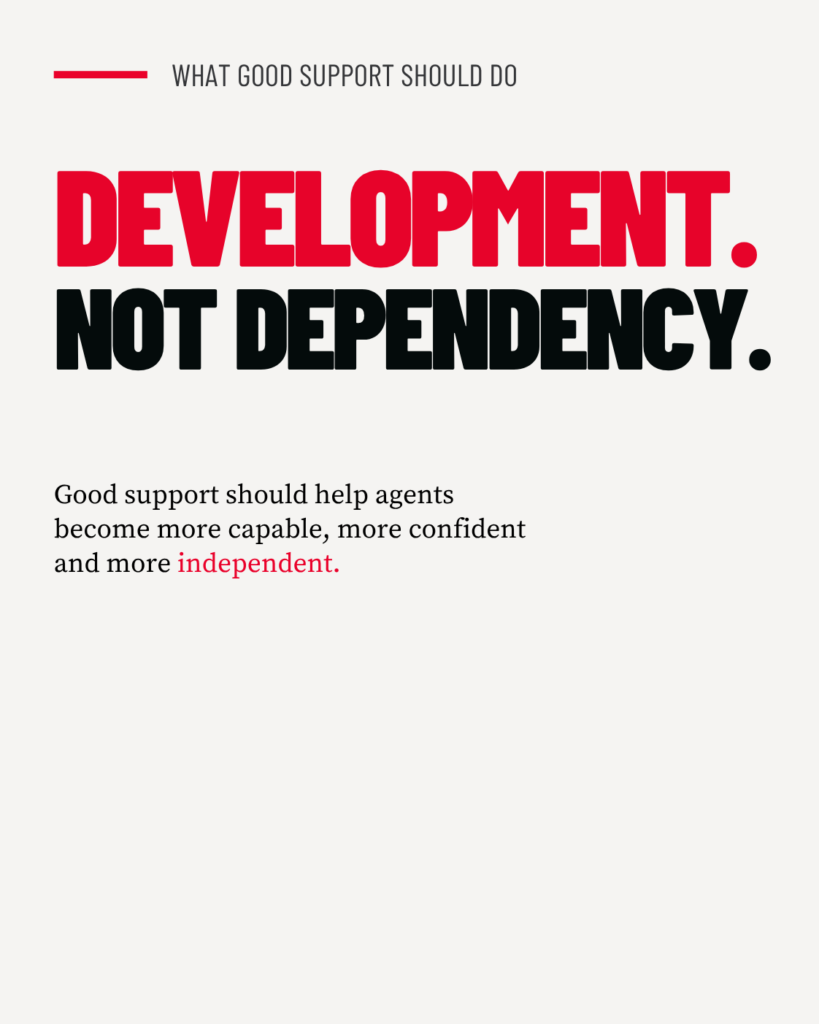
Support shouldn’t create dependency
There’s an important balance here.
In the last article, I compared the agent to the cyclist and the brokerage to the bike.
The cyclist still has to pedal.
Your brokerage can’t make your calls for you. It can’t build genuine client relationships for you. It can’t make you attend training, follow up with leads or implement a business plan. And it shouldn’t.
Good support should make agents more capable and more independent over time, with good people and good systems still behind them when they need them.
Role-playing that difficult client conversation is a good example. Your broker is never going to make that call for you. The practice is there so you make it better yourself.
Before you decide the brokerage is the problem
If you recognize yourself in one or more of these questions, I wouldn’t immediately conclude that you need to change brokerages.
Have the conversation first.
Maybe the support exists and you haven’t been using it. Maybe your needs have changed as your business has evolved. Maybe the people around you don’t know that you want more help. Maybe you’ve become more experienced and what you need from a brokerage today is completely different from what you needed when you joined. That’s also why it can be useful to step back and think about what kind of brokerage actually fits the career you’re trying to build.
Or maybe the conversation shows you that what you need and what your brokerage is designed to provide really are different. Better to know that than to guess.
I’m not asking these questions to talk anyone into leaving. I’m asking so you get clear on what you actually need.
These questions apply to us too
I think it’s important to turn these questions back on ourselves at Noralta.
If an agent here doesn’t know who to call, has stopped asking because asking doesn’t feel worthwhile, continually discovers problems too late, or doesn’t feel like the environment around them is helping them get better, pointing to a list of programs isn’t a very good response. We need to look at the experience they’re actually having.
Our broker support structure includes me and three Associate Brokers providing seven-day on-call coverage, backed by a 12-person support team working across conveyancing, listing administration and broader agent support.
I’m proud of that structure. But the structure only matters if it works when an agent actually needs it.
The same is true of the work we put into training, coaching and our Monday Morning Meetings. Holding the meeting is the easy part. The real test is whether someone walks out better at their business than when they walked in.
I don’t expect every question to be answered immediately or every interaction to be perfect. I do want our agents to know where to go, that someone is interested in helping them, and that asking for help is welcomed.
That’s what we’re working toward.
If you’re curious about how that broader support system is structured at Noralta, you can see what working here looks like.
Rather than asking “Is my brokerage good or bad?”, I’d ask four more useful questions:
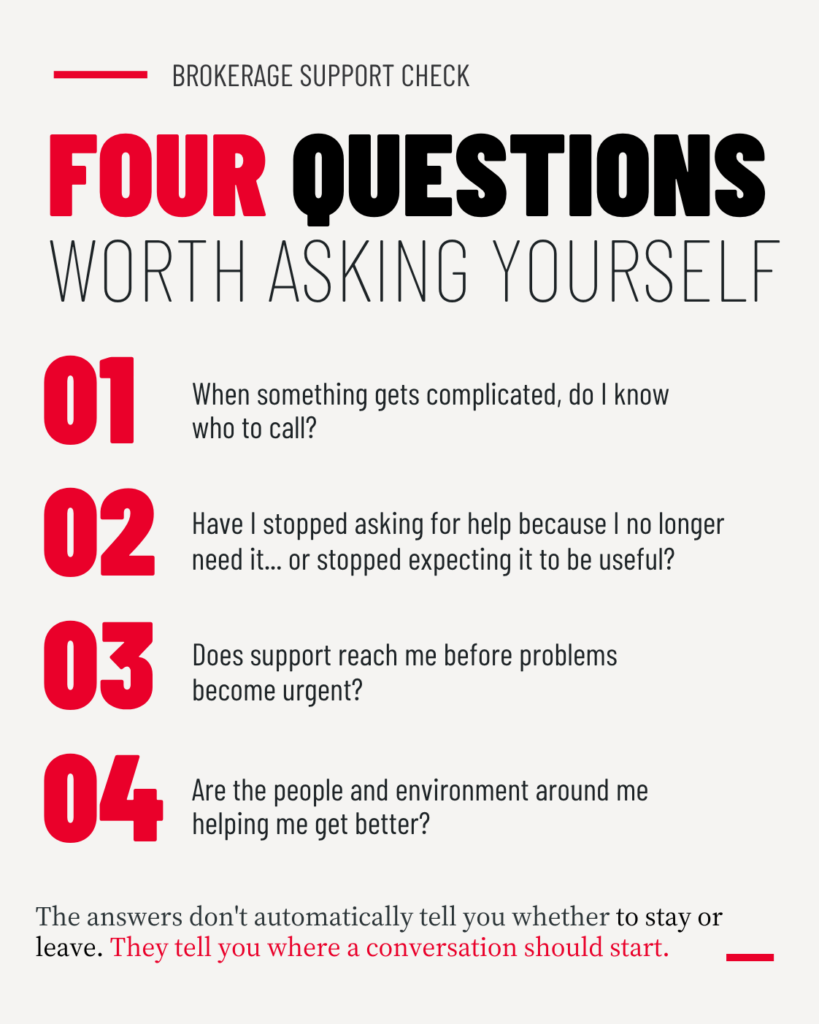
And if you’re considering a brokerage change, they give you much better questions to ask the next brokerage than simply: “What support do you offer?”
Where to go from here
If a couple of these questions hit home, pay attention to that.
Start by getting clear about what you actually want from your brokerage. Then have the conversation where you are.
Take the Brokerage Alignment Quiz, or reach out if you’d rather talk through what brokerage support could look like for your business. Either way, it’s just a conversation.
Frequently Asked Questions
How do I know if my real estate brokerage isn’t supporting me properly?
Start with your own experience. Do you know exactly who to contact when something gets complicated? Do you still feel comfortable asking for help? Are issues being identified early enough to deal with them? And are the people and environment around you helping you become better at your business?
Is it normal to need less brokerage support as I become more experienced?
Yes. The type of support an agent needs should change as their experience and business grow. The important distinction is whether you’re becoming more independent because you’re more capable, or simply doing everything yourself because you’ve stopped expecting useful support.
What does good broker support look like day to day?
Often, it isn’t dramatic. It can be accessibility, a second opinion, a timely question, help preparing for a difficult client conversation, or the confidence of knowing someone knowledgeable is available when you need them.
Why does a brokerage’s agent community matter?
A collaborative environment gives agents access to more than formal training or broker knowledge. Other agents bring their own transactions, market experience, ideas and lessons to the group. When that knowledge is shared, one person’s experience can become something everyone learns from.
Should I switch brokerages if I recognize these things in my current situation?
Not automatically. Start with a conversation with your current brokerage. Your needs may have changed, you may not be using resources that are already available, or there may be a gap that can be addressed. If what you need and what the brokerage is designed to provide are fundamentally different, then it may be worth considering your options.
What kind of broker support does Royal LePage Noralta provide?
Noralta’s broker support includes Tom Shearer and three Associate Brokers providing seven-day on-call coverage, backed by a 12-person support team working across conveyancing, listing administration and broader agent support.