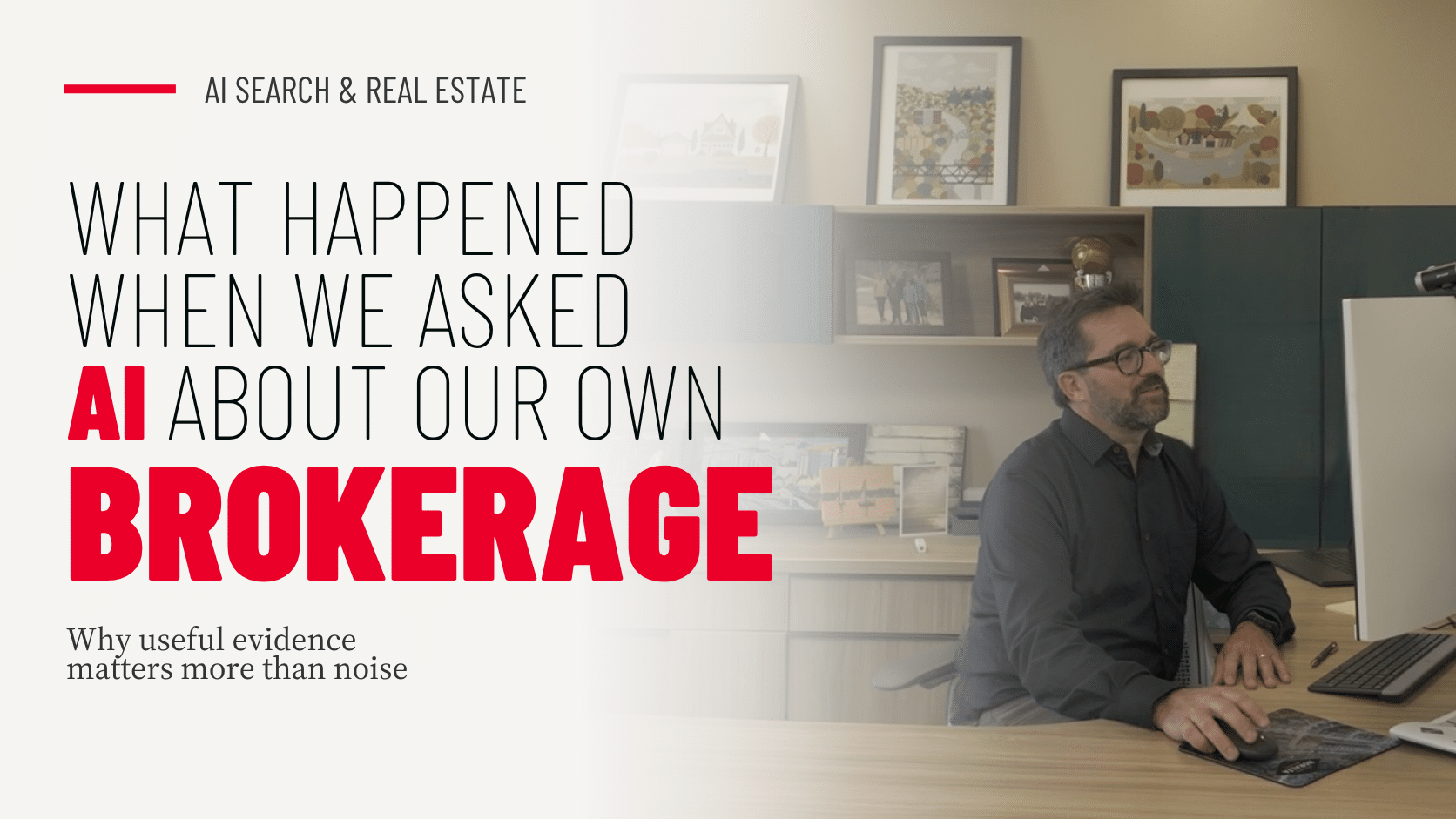
Being good at the work still matters most. But if the evidence of that work is nowhere to be found, an AI assistant cannot use it.
When I started in real estate, one of my first jobs was building a contact database. I ordered software that arrived on 12 diskettes and loaded it onto the 2 GB hard drive in my computer. I pulled out my leather-bound address book, used a reverse directory and racked my brain trying to remember everyone I knew who might be willing to work with me. Then I did open houses, wrote classified ads for the newspaper and mailed out listings I thought people might be interested in.
Looking back, the one thing I wish I’d done more of was much simpler: pick up the phone and go talk to people I knew.
A lot has changed since then. But people still need to decide whom they’re prepared to trust with a real estate decision. What’s changing again is how they make that decision.
People are doing their homework before they meet you
I learned this lesson well before artificial intelligence entered the conversation.
I once received a call from a seller who was planning to list his condo. It was a building where I’d already done business, so I assumed that was probably how he’d found me. After we finished the paperwork, he surprised me.
He told me he’d called me because I was a runner.
Just like him.
Somewhere on my website, buried in a profile I’d written about myself, I’d mentioned running. He had searched me before we met. He looked at the properties I’d listed, my online profiles and the kind of work I was doing. Somewhere in that process, he found a small personal detail that made a connection.
That stuck with me. By the time a prospective client contacts you, they may already know considerably more about you than you know about them.
For years, that homework increasingly happened through Google, websites, social media and online reviews. Now another shift is happening.
From searching for answers to asking for answers
People can now ask ChatGPT, Gemini or Perplexity the kinds of questions they once typed into a search engine. Should I rent or buy in Edmonton? What should I know before selling a condo? Which neighbourhood might suit my family? How do I know what my home is worth? How do I choose a REALTOR®?
The important difference is that instead of being presented with a page of links and deciding where to look next, a consumer may receive an assembled answer.
That creates an interesting question for us as a brokerage. We know what we believe about ourselves. We know the experience of the people in our offices. We know the work that goes into supporting our clients and agents. But what can an AI system actually find?
So we decided to ask.
We tested AI on our own brokerage
Our team reviewed how Royal LePage Noralta Real Estate appeared in AI-generated answers, using several measurement tools alongside our own search data.
We actually found problems with how some of the measurement tools were configured before we learned much about ourselves. We corrected those issues and decided to treat the results as a fresh starting point rather than pretend we had a clean historical comparison.
What came back was useful, and some of it was uncomfortable.
When questions were specifically about choosing a brokerage, Noralta appeared and what was said about us was overwhelmingly positive. But when the questions moved into the everyday things consumers actually want to know, we appeared much less often.
That made me wonder why. We have more than 175 REALTORS® working across four offices. There are decades of accumulated experience in those offices.
Where was it?
One part of the answer became pretty obvious. A great deal of what we know has never been published anywhere that a person, a search engine or an AI system can find it.
We take experience for granted
One of our experienced agents put this particularly well after a development session. He pointed out how much experience we take for granted.
Think about everything that happens over the course of a real estate career. The negotiation that almost went sideways. The inspection issue nobody expected. The difficult conversation that eventually worked. The unusual condition in a contract. The neighbourhood question that required more than a quick answer. The market change that forced you to rethink your advice.
You learn from it and move on. Some of that knowledge makes its way into our internal systems, some gets shared with another agent, some gets discussed in a meeting. And some of it simply stays in someone’s head.
New agents remind me of this all the time. They’ll look at everything that can happen in this business and essentially ask: how am I ever going to know all of this?
The answer is that you don’t learn it all at once. Experience is hard-fought, recall develops over time, and surrounding yourself with people who have already accumulated that experience is incredibly valuable.
Our AI review made me realize there’s another side to that.
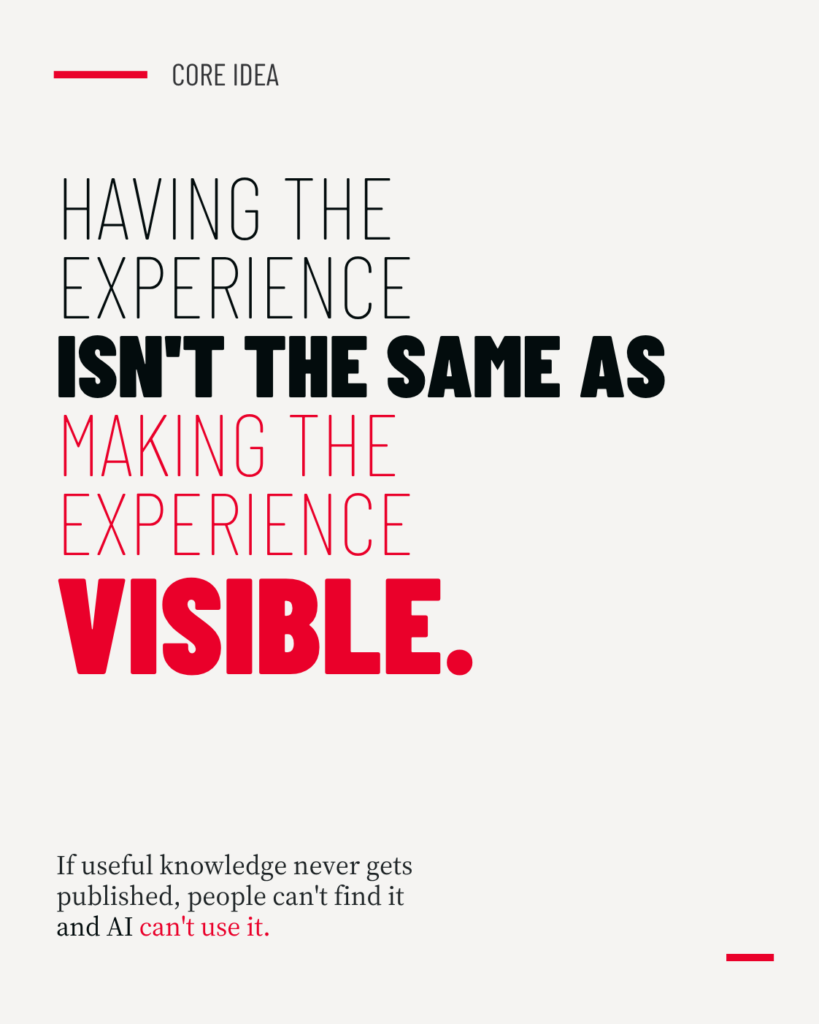
Having the experience isn’t the same as making the experience visible.
Expertise that stays inside the building is invisible expertise
I see the value of shared experience in our Monday Morning Meetings. Our agents value personal and professional growth, and when people are constantly learning, they bring their clients, transactions and businesses into those conversations with them. We talk about what’s changing in the market, difficult transactions, regulatory issues, client conversations and what is or isn’t working in our businesses.
And we don’t forget where we’ve come from. Someone in the room has usually seen something similar before. The knowledge compounds because one person’s experience becomes available to everyone else.
But compounding knowledge inside the room isn’t the same as making that knowledge visible outside the room. An AI assistant can’t walk into one of our Monday Morning Meetings. It can’t phone one of our offices and ask an experienced REALTOR® what they’ve learned about a particular neighbourhood. It works with what it can find.
Our own community pages made the point. Many contain listings, a heading and a map. There’s nothing necessarily wrong with that information, but imagine someone asking what it’s actually like to live in Parkview or Lendrum. A listings widget can’t tell much of that story.
Our agents work in these communities. They know the questions clients repeatedly ask, the differences between pockets of a neighbourhood, how housing types change and the practical considerations that don’t appear in a listing description.
We already have much of the knowledge. The challenge is giving that knowledge somewhere to live. That might be an article, a useful neighbourhood page, a video, a market explanation, a thoughtful agent biography, or an answer to a question clients ask again and again.
It doesn’t need to be content for the sake of producing content. It needs to be useful.
The part that mattered more than word count
There was another finding I think is even more important. When these systems compared full-service brokerages, there wasn’t much published evidence available to differentiate organizations based on results.
That’s worth thinking about. Real estate businesses naturally use words like experienced, professional, exceptional service, trusted advice and local expertise. Those things may all be true. But eventually a consumer, and increasingly the systems helping that consumer, needs to ask: what can you actually show me?
There’s an important standard here.
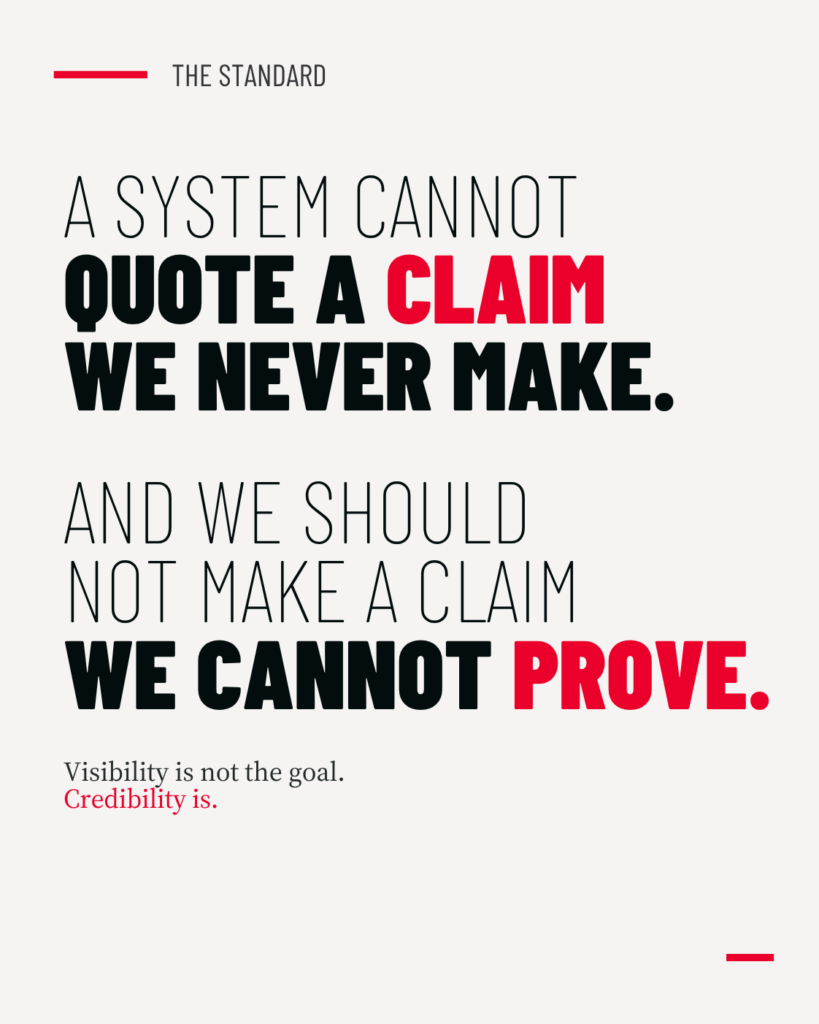
A system cannot quote a claim we never make. And we should not make a claim we cannot prove.
I care about both halves of that statement.
The answer isn’t to go hunting for a statistic that makes us sound impressive. If we’re going to make a performance claim, I want to know what the number actually measures. I want a defined time period. I want to understand the methodology. And I want us to be comfortable standing behind it publicly.
We’re working through which measures meet that standard. I’d rather publish a smaller number that we can properly explain than a spectacular-looking number that doesn’t withstand scrutiny.
Visibility isn’t the goal. Credibility is.
Reviews are evidence too, but they answer a different question
Our review reputation came back strongly in the work we did, and I’m pleased about that. Reviews matter because they represent people who actually worked with us and were prepared to talk publicly about their experience.
But reviews and operational measures answer different questions. Reviews can help someone understand what it felt like to work with an agent or brokerage. A properly defined performance measure can provide another piece of evidence about the work itself.
Over time, I think a credible real estate organization should be prepared to earn and show both.

One finding genuinely changed how I think about our website. Our Edmonton office page repeatedly appeared as a source in the answers we reviewed.
It’s an office page. I had never thought of it as an authority piece.
The first thing we found there had nothing to do with artificial intelligence. My own photo had been broken on that page since July. Nobody had noticed, including me. That is a small thing, and it was also a page the systems were using as a source.
AI systems don’t necessarily see our website the way we do. They are looking for useful information they can understand and use to answer a question. That means a page we think is administrative might be genuinely useful, while a page we’ve spent considerable effort making beautiful might contribute very little if it doesn’t actually answer anything.
So an office page should do more than say where the office is. A community page should do more than show what’s for sale. An agent biography should do more than list credentials. Every page is an opportunity to answer a question.
If you’re choosing a REALTOR® right now
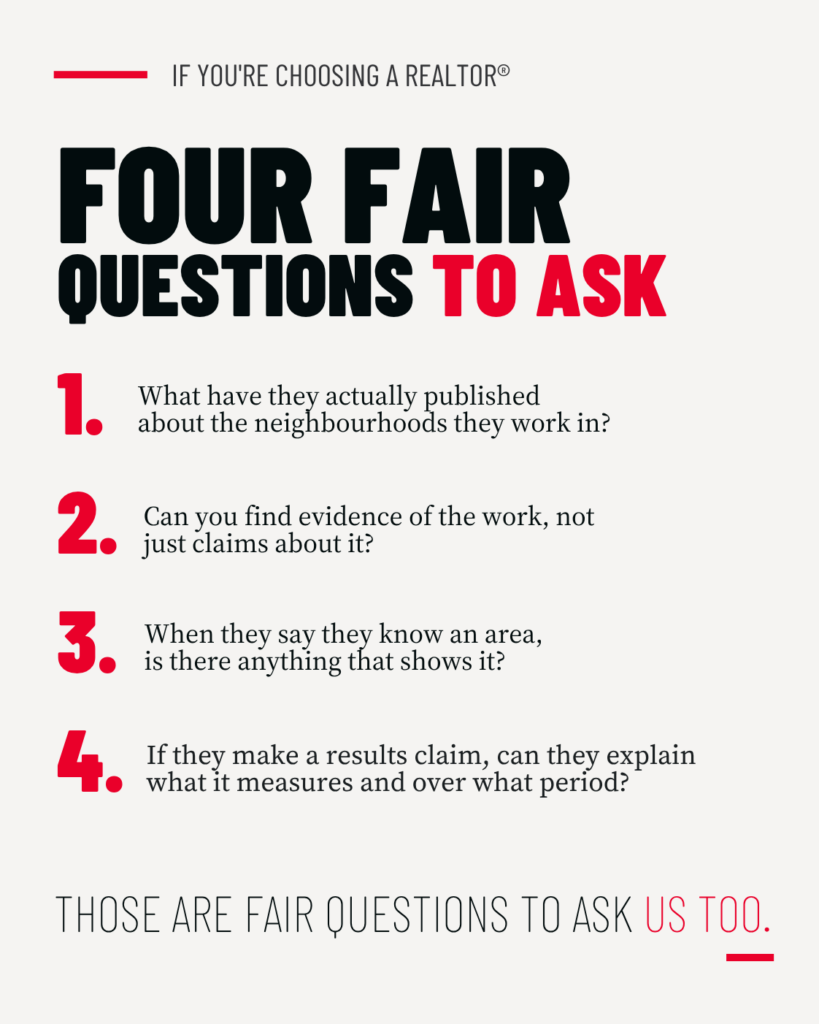
You don’t need to audit anybody. But the same questions we asked ourselves are reasonable ones to ask of anyone you’re considering. What have they actually published about the neighbourhoods they work in? Can you find evidence of the work, or only claims about it? And when they make a claim about results, can they tell you what it measures and over what period?
For me, real neighbourhood expertise goes much deeper than knowing what sold last month.
A true neighbourhood specialist knows the names of the kindergarten teachers at the local school. They know where the best off-leash areas are. They know which communities suit someone who wants a smooth commute home at the end of the day.
They can picture the interior of a house that sold recently and tell you what was genuinely good about it, or what a buyer would have needed to think twice about. They’re in tune with who’s building, who’s renovating and what’s changing on a street.
They’re well connected to a handyman and a renovator. They know the community board, and they can probably help if you want to book the hall for a get-together.
That’s the difference between having access to neighbourhood data and actually knowing a neighbourhood.
Those are fair standards to hold us to as well.
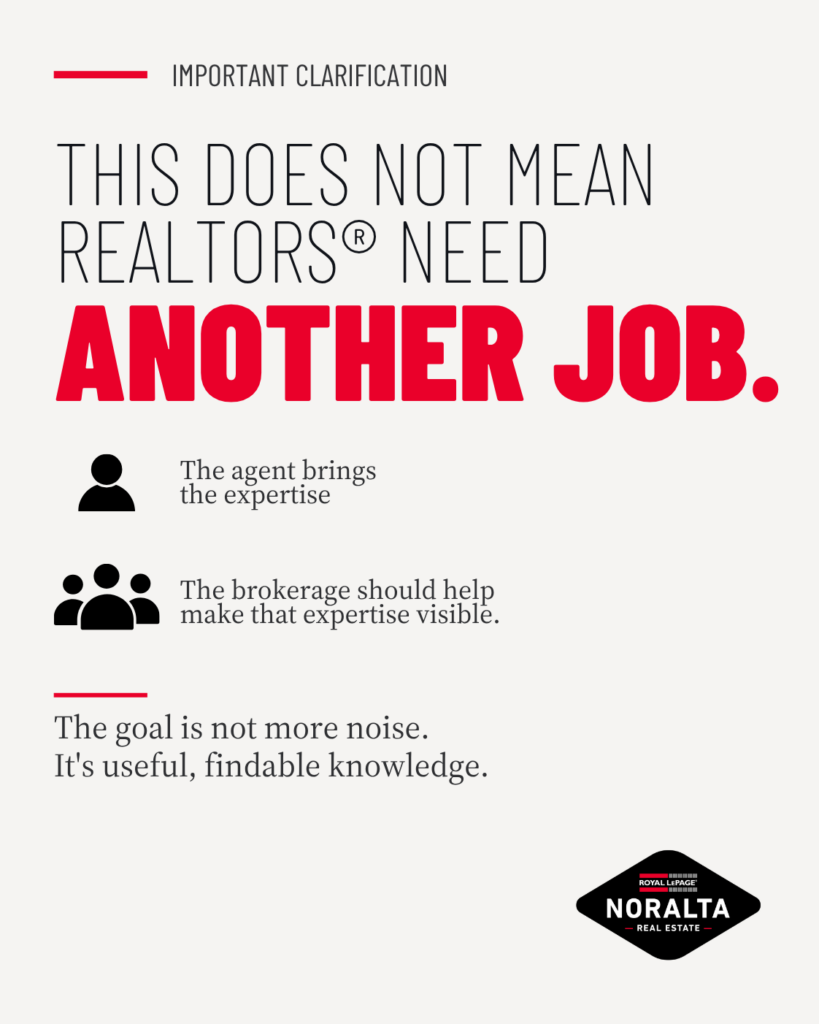
There’s a version of this article that ends with a long list of chores for agents, and I want to be careful not to write it.
The obvious response is to tell agents they need to create more content. Write articles. Record videos. Optimize their websites. Learn SEO. Understand AI. Post more often.
I don’t think that’s the answer. If we tell a great REALTOR® that they now also need to become an expert blogger, videographer, SEO strategist and AI marketer, we haven’t solved anything. We’ve just created more work.
The better question for the brokerage is: how do we make it easy for the agent’s knowledge to become visible?
The REALTOR® should bring the expertise. They know the client question they answered three times this month. They know the neighbourhood. They know why a particular transaction was complicated. They know the conversation sellers are struggling with in this market. The support around them should help capture and package that knowledge.
That’s an area where I see an important role for our Agent Success team and Studio. Maybe the agent has the conversation and someone else helps turn it into an article. Maybe a question becomes a short video. Maybe local knowledge gets incorporated into a community page. Maybe we make it easier to keep profiles accurate and collect reviews.
The agent still owns the relationships. The agent still needs to know their craft. The agent still does the work. Our job as a brokerage is to remove the friction around making that work visible.
What we’re changing
The point of doing an audit isn’t to admire the score. It’s to decide what we’re going to do differently.
First, we’re getting the measurement right so we have a credible starting point. Then the work gets practical. We’re looking at how we can put more genuine community knowledge onto our community pages. How our office pages can answer more than location questions. How video and social content can teach something instead of simply announcing something. How we keep business information accurate. How we help our agents’ experience become easier to find.
And when we believe Noralta does something particularly well, we’re asking whether there is a verifiable measure behind it that we’re prepared to publish.
Not because an AI system needs to be impressed by us. Because showing our work makes it easier for anyone to decide whether we’re worthy of their trust.
What hasn’t changed
The technology is new. The standard underneath it really isn’t.
Be useful. Be specific. Be accurate. Know your market. Do good work. Share what you’ve learned. Make claims you can support.
When I started in real estate, I probably should have spent a little less time loading those 12 diskettes and a little more time picking up the phone and talking to people. The tools have changed dramatically since then, but I don’t think the fundamental lesson has.
Meet people where they are.
Today, sometimes that starts with a conversation. Sometimes it starts with a Google search. And increasingly, it may start with a question someone asks an AI assistant.
Being good at the work still matters most. But if the evidence of that work is nowhere to be found, neither a person nor a machine has much opportunity to discover it.
Thinking about buying or selling in Edmonton and area? Connect with a Royal LePage Noralta REALTOR® who knows your neighbourhood. Our offices are in Edmonton, Sherwood Park, Fort Saskatchewan and Spruce Grove.