Updated: September 2026 · Last verified: September 29, 2026 · Verification owner: Diana McGee
A real estate career can take up as much of your life as you’re prepared to give it.
There is always another call you could make, another client you could follow up with, another marketing idea you could try or another transaction that needs attention.
Working hard isn’t necessarily the problem. I’ve built much of my own career by working hard, and there are times when that’s exactly what building a business requires.
I think the more important question is: what are you working toward?
Before we talk about how to build a bigger real estate business here in the Edmonton area, I think we should ask what you want that business to make possible.
What would your perfect life actually look like?
The idea behind what we now call Real Estate Life by Design started for me at a forum retreat.
A facilitator asked a relatively simple question: “What would your perfect life look like?”
Then they added something that changed the question for me: “Don’t give me the answer you think other people want to hear. Especially your parents.”
That really sunk in.
I started thinking about how easy it is to build a career around other people’s definitions of success.
Real estate has no shortage of advice about what agents should be doing. Sell more homes. Make more calls. Build a team. Get more leads.
Any one of those things might be exactly right for you. But they’re not the destination.
The question I became more interested in was: what do you actually want your life and career to look like?
Once you have some clarity about that, you can start designing the business that helps you get there.
Someone else’s successful business may not work for you
I worked with an agent who had a mentor they admired and wanted to emulate. The mentor was successful, so it seemed reasonable to look at how they operated and try to do the same things.
There was nothing wrong with the mentor’s approach. It just didn’t fit the agent.
The agent had to use a tremendous amount of personal energy just to get into character. They could do it for a while, but it wasn’t natural. Eventually they would burn out, pull back or start doing things that undermined the progress they had made.
Once they started finding their own style, something changed. The business became more interesting to them. They weren’t trying so hard to behave like the person they thought a successful REALTOR® was supposed to be. They could start building around the person they actually were.
Learn from successful people, absolutely. Just don’t try to become them.
Start with what drives you
When I’m working with an agent on their business, I don’t necessarily start by asking how many homes they want to sell.
I want to understand what drives them. Why are you doing this?
Maybe you want to be a great provider for your family, or being the best at something matters to you. Maybe you love the camaraderie of working alongside other people. Or maybe it’s independence, recognition or enough flexibility to be very present somewhere else in your life.
None of those answers is inherently better than another. But the answer matters because different motivations can lead to very different businesses.
Once we understand what actually drives someone, we can start looking for a path that feels more natural to them. That’s very different from saying, “Here’s the model. Go execute it.”
Busy and successful aren’t necessarily the same thing
It’s easy to use production as the primary measurement of a real estate career because it’s easy to count. Transactions. Volume. GCI. Rankings.
Those numbers matter. This is a business, and it needs to be economically viable. But they don’t tell you everything.
I worked with an agent who was already doing very well. They were a top producer and had built a substantial business. The challenge was that they had reached a point where both their sales volume and their available time were essentially maxed out. Doing more of exactly the same thing wasn’t an especially compelling answer.
So we looked at the business differently. Much of their existing business was in starter homes, but this agent had a genuine interest in luxury lifestyles and higher-end properties. We started exploring what it would look like to move more of their practice toward executive and luxury homes.
It wasn’t only about selling more houses. It meant building around a market the agent cared about, with the potential for better economics that didn’t depend on doing more and more transactions.
Sometimes you don’t need more business. You need a different business.
What does a good real estate career look like?
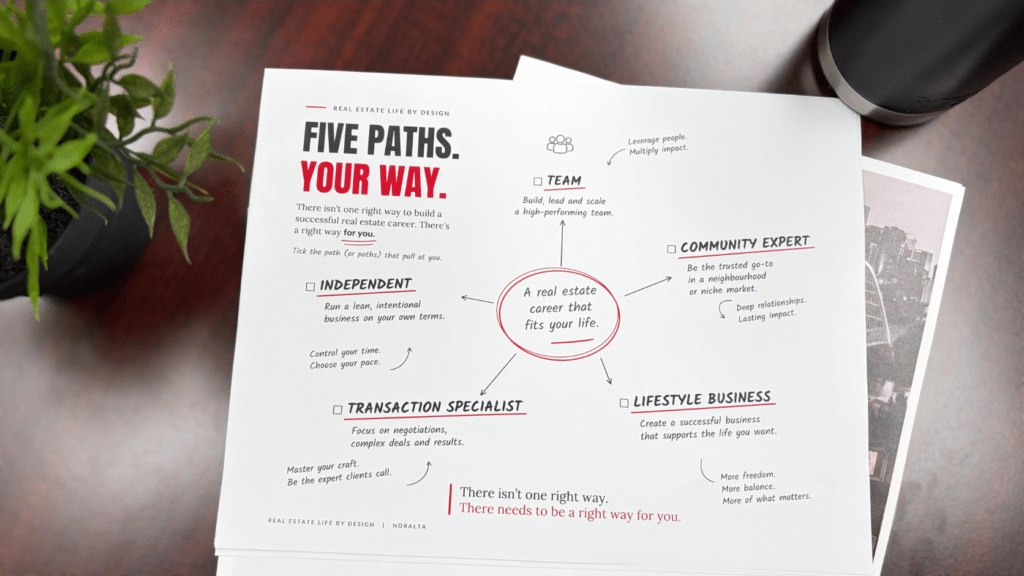
One agent may want to build a large team and eventually move away from day-to-day production. Another may want a lean independent practice with a relatively small number of deeply connected clients. Someone else may want to become the dominant REALTOR® in a particular community. Another may love negotiation, speed and the energy of transactions. Someone may want to build a substantial business and is perfectly comfortable committing a large amount of time and energy to doing it.
Those can all be successful careers. The important thing is that the business and the person fit.
Your real estate business should be designed to support the life you want. Your life shouldn’t have to continually reorganize itself around the business you’ve accidentally built.
That’s the thinking behind Real Estate Life by Design at Noralta. It starts with the life. The production target comes later.
What matters to you? What drives you? What do you want your career to provide? What do you want enough room in your life to keep doing? What kind of work gives you energy, and what kind continually takes it away?
Then we can start designing the real estate career around those answers.
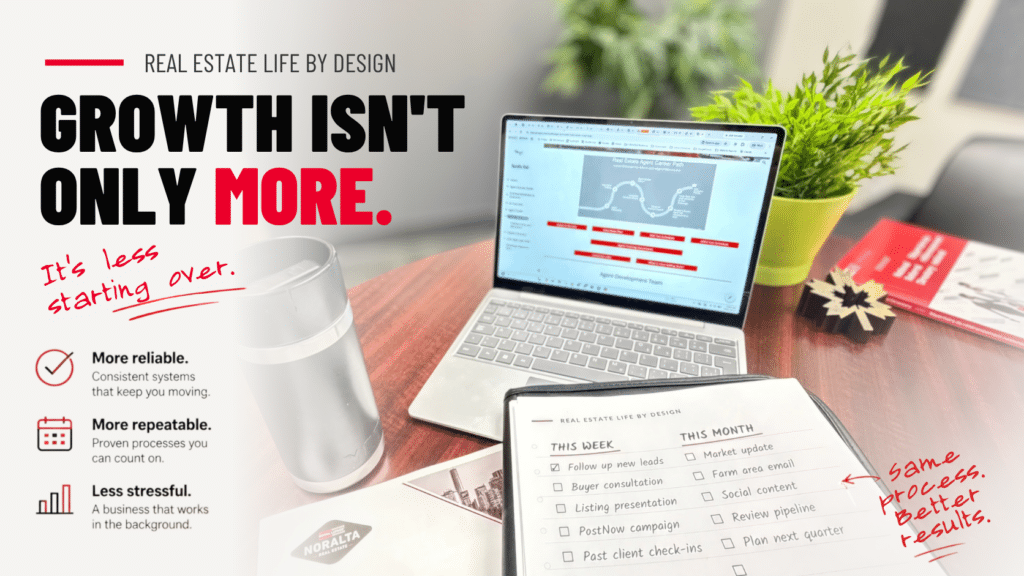
Success should become more reliable, not just bigger
My own definition of success in real estate has evolved over the years.
Today, I think a successful real estate business should become reliable, repeatable and less stressful over time. You should have a plan, know where your business comes from and get more comfortable with the work you’re doing and the clients you serve.
And I think you should eventually have enough of a steady base that you can experiment. Try a new marketing idea. Explore a different market. Develop another source of business. Change something that isn’t working.
There’s a big difference between experimenting because you’re curious about what might make your business better and constantly searching for the next thing because you don’t know where your next client is coming from.
Real estate will always have hard work and uncertainty. Reliability means building enough structure underneath your business that every month doesn’t feel like you’re starting over.
The questions I’d ask myself
If you’re wondering whether your real estate career actually fits your life, I wouldn’t start with your production numbers. I’d start with a few different questions:
- What actually drives me? What am I hoping this career makes possible?
- Am I building a business that fits me, or am I trying to imitate someone else’s version of success?
- What parts of this business give me energy, and what parts require me to constantly get into character?
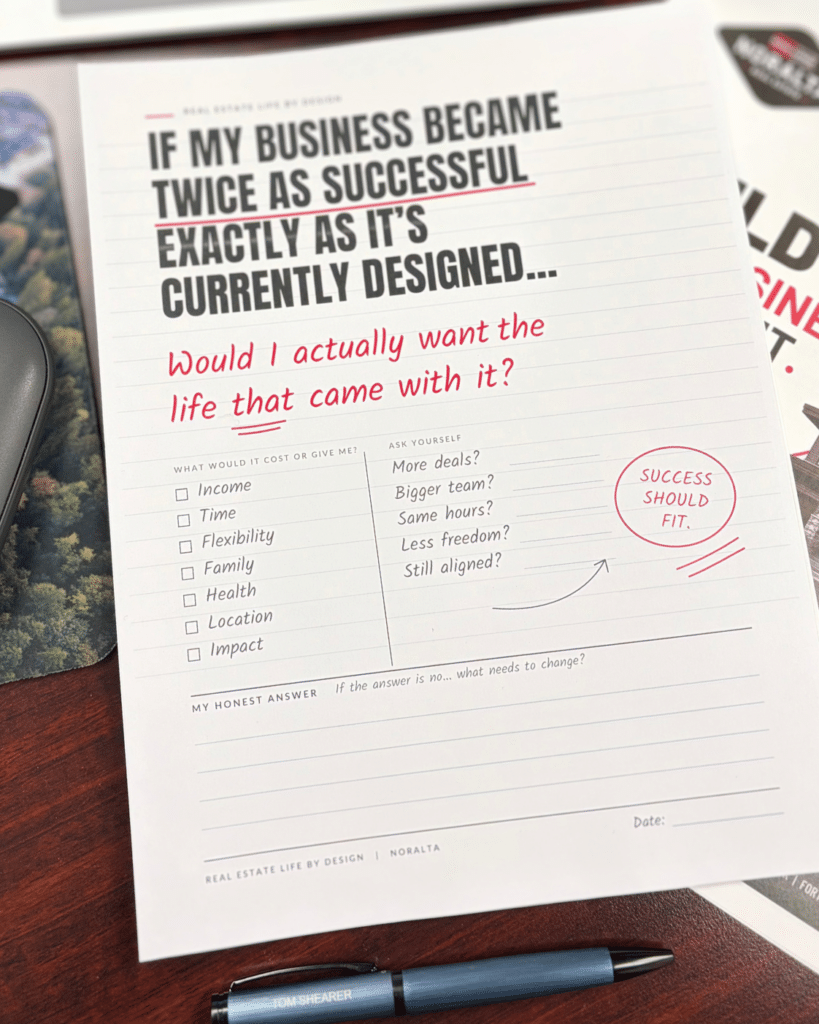
If my business became twice as successful exactly as it’s currently designed, would I actually want the life that came with it?
- Is my business becoming more reliable and repeatable, or am I continually starting over?
I particularly like that fourth question. Because sometimes the problem with a business model becomes much easier to see when you imagine it working even better.
If doubling it sounds exciting, you’re probably learning something. If doubling it sounds exhausting, you’re learning something too.
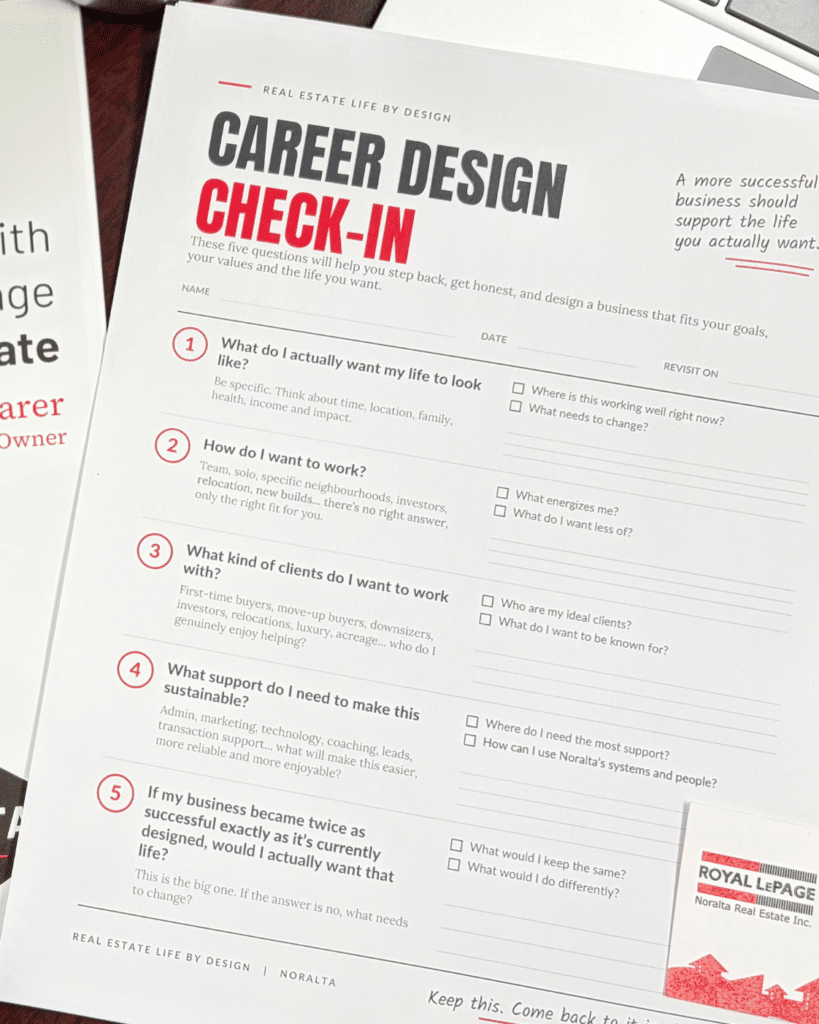
Take this with you.
The Career Design Check-In gives you five questions to work through now, then revisit as your business and life change.
You don’t necessarily need to start over
If you realize that the business you’ve built doesn’t quite fit anymore, that doesn’t mean everything you’ve done was wrong.
Your life changes. So do your motivations, your family and your financial needs. And you become a different REALTOR® as your experience grows.
The answer may not be to tear the business down. It might be changing the clients you pursue, changing how you prospect, becoming more intentional about your schedule, building a team, leaving a team, moving into a different market, adding leverage, or simply deciding that you don’t actually want to chase the next production milestone.
The important part is making those decisions deliberately.
Where to go from here
Real Estate Life by Design starts with a question I was asked years ago: what would your perfect life look like?
But I’d add the same warning I was given: don’t give the answer you think you’re supposed to give.
Once you can articulate what you actually want, you can start asking a much more interesting question: what kind of real estate business would help me build that life?
That’s where career design starts. And if you’re asking those questions while also thinking about whether your current brokerage actually supports the career you’re trying to build, that’s a question worth exploring too.
If you already know the kind of business you want, the next question is how you’ll build it. I wrote about that in finding the coaching style that works for you, and why a good strategy can still be the wrong strategy for you.
Explore Your Brokerage Fit with our Brokerage Alignment Quiz, or if you’d prefer to talk it through directly: Book a conversation with Tom.
Frequently Asked Questions
How do I know if my real estate career fits my life?
Start by getting clear about what you actually want your career to provide. Consider what drives you, what kind of work gives you energy, what you want your life outside real estate to contain, and whether your current business is moving you toward those things.
Can real estate be a sustainable long-term career?
It can be, but sustainability will look different for different agents. It’s worth examining whether the way you’ve built your particular business fits your personality, motivations, financial needs and priorities, especially if maintaining it continually requires you to work in a way that doesn’t feel natural.
Does a bigger real estate business mean a better career?
Not necessarily. Production matters, but it’s only one measure. A bigger business that requires more time, energy or responsibility than you want may not be a better business for you. Sometimes the opportunity is to change the type of business rather than simply increase the amount of it.
What is Real Estate Life by Design?
Real Estate Life by Design is an approach we use at Royal LePage Noralta that starts with the life and career an agent actually wants and then works backward toward the business that can support it. The goal isn’t to give every agent the same formula, but to help them articulate what success looks like for them.
Can I change my real estate business without starting over?
You may not need to start over. Existing relationships, skills, systems and experience still have value. The change may be in the clients you pursue, the way you generate business, the market you work in, your schedule, your structure or simply the outcome you’re building toward.
What does a sustainable real estate business look like?
For me, it’s a business that becomes increasingly reliable, repeatable and less stressful over time. The agent understands where business comes from, has a plan they can execute consistently and has enough of a steady foundation to experiment with new ideas without constantly reinventing their practice.