Updated: September 2026 · Last verified: October 14, 2026 · Verification owner: Diana McGee
When we talk about what a real estate brokerage provides, coaching and business development don’t always make the list.
There’s the obvious work: contracts, compliance, conveyancing, administration and helping agents navigate the challenges that come with transactions. All of that matters.
But I’ve increasingly come to believe that a brokerage can also play a role in helping agents become better at building their business.
That’s something we’re trying to do more deliberately at Noralta.
It doesn’t mean we have the one right way to sell real estate. In fact, my experience has pushed me in almost the opposite direction.
There are some very good coaching programs, sales systems and prospecting models available to REALTORS®. I’ve learned from many different people and approaches over my career.
The more interesting question is what happens after you learn the model: which parts actually fit you?
Because excelling in this business isn’t just about finding a successful approach. It’s also about understanding yourself well enough to recognize which approaches you’re most likely to execute consistently.
Two ideas that changed how I thought about agent development
Years ago, I saw Bruce Gardner speak at a session hosted by the REALTORS® Association of Edmonton. He talked about different styles of building a real estate career.
Around the same time, my brother-in-law, Michael Moreau, had become involved with a company called TRAITS, previously known as Profile.
Their work was based around an idea I found interesting: the right person in the right role.
An individual completes a questionnaire and their traits are mapped to help understand how different personality characteristics may be better suited to different situations and types of work.
I started putting those two ideas together.
If people naturally have different strengths, communication styles and ways of working, why would we expect all of them to build a real estate business in exactly the same way?
That thinking eventually became part of how we’ve approached our Seven Success Styles at Noralta.
The purpose isn’t to put agents into boxes. It’s to help them find a better place to start.
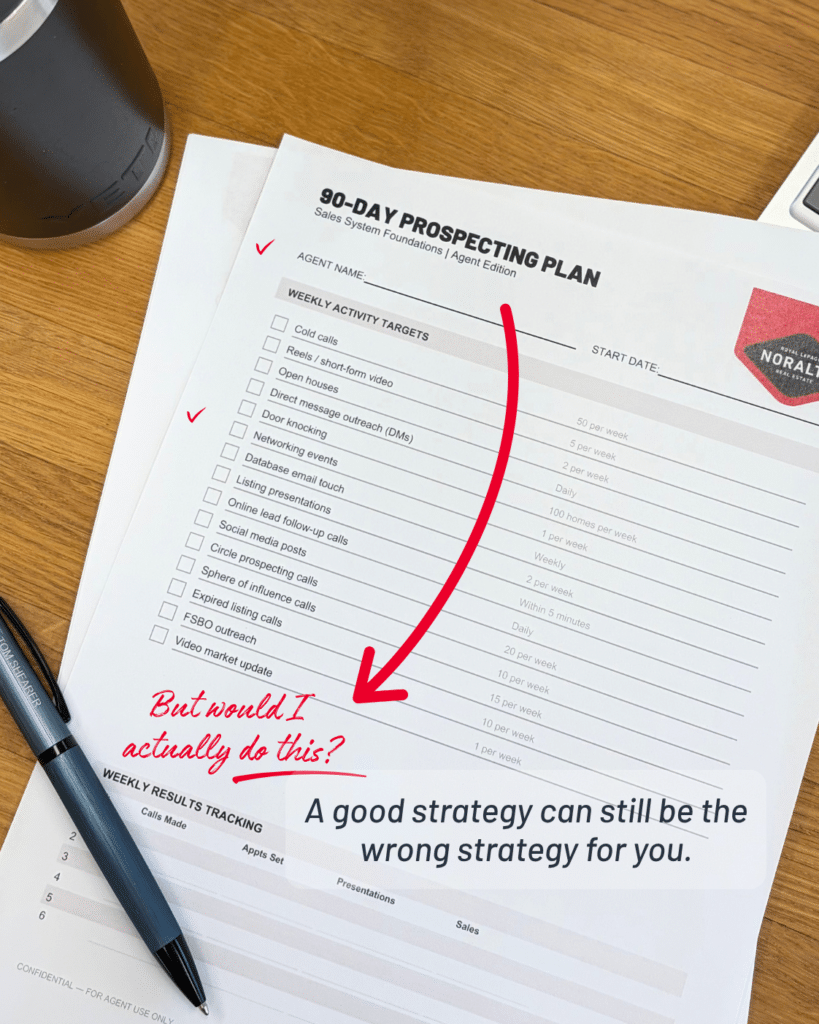
A good strategy can still be the wrong strategy for you
I learned some of this through my own real estate business.
I’ve experimented with many different forms of lead generation over my career, including online leads and direct prospecting.
When some of those leads came in, I found that I didn’t always feel particularly genuine trying to create a connection with the person on the other end.
Part of the problem was probably my own attitude. I didn’t really believe those opportunities were going to work for me.
What worked much better was when there was already some kind of bridge between us. Maybe the person was referred by someone we both knew. Maybe they had seen work I’d previously done. Maybe my reputation or something I had put into the market caused them to call me.
There was already a connection.
Nothing about that experience convinced me that online leads don’t work. Plenty of agents can build successful businesses around them.
It taught me something much more useful:
Just because something works doesn’t mean it’s the best way for me to work.
That’s an important distinction in coaching. We can learn from successful models without assuming we need to copy every part of them.
I’ve watched agents wrestle with the same thing
An agent sits an open house and comes back frustrated. Nobody was serious. There wasn’t enough traffic. The people who came through weren’t actually buyers.
Sometimes that’s simply what happened.
But sometimes there’s something else going on. The agent is half-heartedly trying to generate business through an activity they don’t really believe in. They’re technically doing the activity, but they’re not particularly committed to what it’s supposed to accomplish.
I see another version when an agent tells me they need to do more social media. Then I discover they barely use social media themselves. They don’t naturally spend time there. They don’t interact with people there. They don’t really understand what makes them stop scrolling or engage with something.
Then they spend a significant amount of money creating content that doesn’t particularly look or sound like them, hoping it will somehow create business.
Again, social media isn’t the problem. For another agent, it may be exactly the right environment to build relationships and visibility.
The question isn’t only: does this strategy work? It’s also: does this strategy make sense for this agent?
Seven ways agents actually build a business
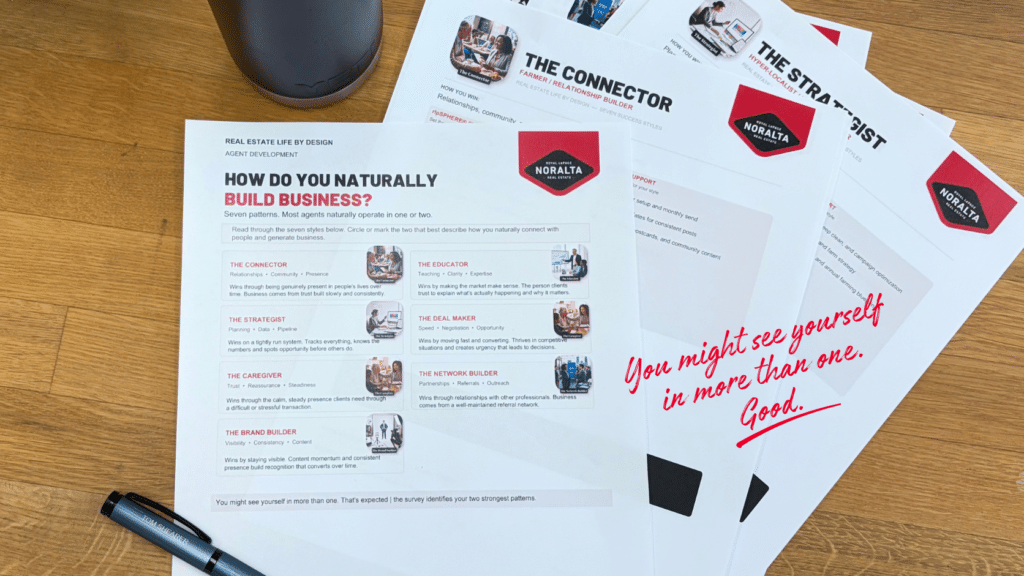
Successful agents don’t all get there the same way. Watch enough careers and a handful of natural patterns show up again and again, not rigid boxes, but true tendencies in how someone builds trust and generates business.
At Noralta, we think about it as seven styles.
The Connector wins through relationships, community and simply being present in people’s lives over time. The Educator wins by teaching, making the market make sense and being the person people trust to explain what’s actually happening. The Strategist wins on planning, data and a tightly run pipeline. The Deal Maker wins on speed, negotiation energy and converting opportunity quickly. The Caregiver wins through trust, reassurance and being the calm, steady presence through a transaction. The Network Builder wins through partnerships, referrals and consistent outbound relationship activity. The Brand Builder wins on visibility, consistency and content momentum.
None of these are better than the others. They’re just different engines, and a coaching approach built around only one of them can underserve the other six.
The brokerage can help with the diagnosis
This is an area where I think brokerages have an opportunity to do more.
Agents are independent business owners. Ultimately, they decide what kind of practice they’re going to build and how they’re going to build it.
But that doesn’t mean they have to figure everything out by themselves.
Part of the work we’re trying to do at Noralta is help an agent look at the evidence in their own business. Where has your business actually come from? What kinds of conversations are you good at? What gives you energy? What do you consistently avoid? What have you tried? What worked? And just as importantly: why did it work?
Our Selling by Design survey is one tool we’ve developed to help start that conversation. It asks questions about the things an agent does naturally, the activities that bring them energy and the ways they tend to interact with other people. The survey generates two possible style matches.
I deliberately say possible. The result isn’t meant to announce, “This is what you are, and therefore this is how you have to sell real estate.” It’s a conversation starter.
We’re trying to help agents discover the types of prospecting and business development that might work best for them, rather than pushing them into an unnatural fit.
There are simply too many legitimate ways to generate real estate business to assume everybody needs the same one.
I worked with an agent who wanted to build what I’d describe as a billboard-style business. He felt he was good at connecting with online leads, so he spent heavily on magazine advertising and other broad visibility tactics.
But when we looked more closely, the pieces weren’t lining up. He wasn’t pursuing the volume of opportunities that kind of strategy needed, and he wasn’t consistently available to work the leads when they arrived.
We started looking at ways to focus his lead generation more specifically toward people with stronger real estate intent. One strategy was advertising other agents’ listings, with their permission, to connect with more serious buyers.
He ultimately did more business while spending less on the broader advertising approach.
What mattered wasn’t that we’d discovered the “right” prospecting strategy. We had found a better fit between the agent, the opportunity and the way he was actually prepared to work.
Another agent I worked with really enjoyed educating clients. They liked explaining the buying process, were knowledgeable, comfortable answering questions and also enjoyed hosting a good event.
So we suggested bringing those things together.
The agent started holding new-home-buyer information sessions. That gave them an opportunity to prospect while doing something they were naturally good at. They could teach, answer questions, demonstrate their expertise and host an experience they were proud of.
That started a strong run of productivity over the following months.
We didn’t invent a new personality for the agent. We found a business-development activity that gave them somewhere useful to apply the strengths they already had.
That’s the kind of coaching conversation I’m interested in.
Finding your style isn’t about finding an excuse
There’s an important distinction here.
Working to your natural style does not mean only doing things that are comfortable.
Real estate is a sales business. At some point, agents have to reach out to people. They need to initiate conversations, follow up, ask for business and occasionally hear no.
Until an agent commits to regular prospecting activity, it’s very difficult for their practice to find its legs.
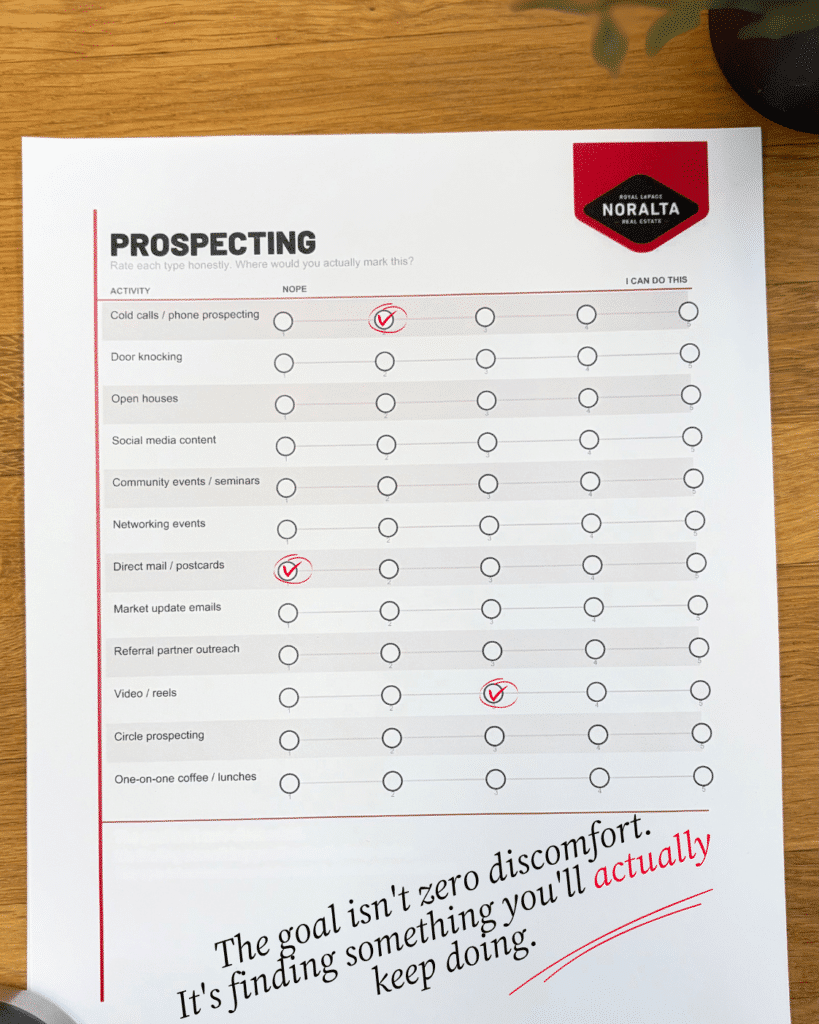
I sometimes describe what we’re looking for as your least uncomfortable form of prospecting.
I don’t mean that negatively. Prospecting involves putting yourself out there. There probably isn’t a version that’s comfortable all the time.
The goal isn’t to eliminate the discomfort. It’s to find a way of doing the necessary work that feels sufficiently natural that you’ll actually keep doing it.
If you enjoy educating people, that might be seminars, workshops or useful market content. If you’re deeply connected to a community, it might be events, conversations and consistently staying in touch. If you’re comfortable picking up the phone and talking with someone you’ve never met, there are very effective strategies built around that. If you genuinely enjoy social media and understand how people interact there, lean into it.
Different approaches. Same responsibility to do the work.
Your style influences how you do the work. It doesn’t eliminate the work.
Before you add another tactic, look backward.

Learning a system and adopting a system aren’t the same thing
I don’t want this to sound like an argument against real estate coaching programs. It isn’t.
I’ve learned from coaches, trainers, other REALTORS® and different sales systems throughout my career. I think agents should continue doing that.
Someone else’s model can expose you to an idea you’ve never considered. A good coach can push you outside your comfort zone, provide accountability and challenge assumptions you’ve made about your own business.
But learning a system and adopting a system aren’t exactly the same thing.
Take the ideas. Try them. Pay attention to what happens. Look at what fits your strengths and where you’re getting results. Be willing to work through discomfort.
But also be willing to recognize when you’re continually forcing yourself into someone else’s model when another legitimate approach may fit you better.
That’s part of becoming better at this business.
Three questions worth asking about coaching
When considering a coaching program, training system or even the guidance you’re getting from your brokerage, I’d ask:
- Does this approach help me understand how I naturally build relationships and business, or am I simply being handed a method to execute?
- If a tactic isn’t working, can we determine whether I need more discipline or whether I should explore a different approach?
- Am I learning principles I can apply to my business, or am I mostly trying to recreate someone else’s business?
That second question may be the most important.
Sometimes the answer really is: you need to do the work.
Other times an agent has been diligently pushing against a strategy that doesn’t fit when another perfectly legitimate approach could make much better use of their strengths.
Good guidance should help an agent tell the difference.

What we’re trying to build at Noralta
In the previous article in this series, I wrote about Real Estate Life by Design and starting with the career and life an agent actually wants.
I think this is the next part of that conversation.
If we’ve started figuring out where you want to go, we can start getting much more thoughtful about how you’re going to get there.
That’s why we’re trying to make coaching, guidance and business development a more deliberate part of Agent Development at Noralta.
Not because we believe we’ve found the one right model for building a real estate business. Quite the opposite.
We’ve seen too many different personalities build successful careers in very different ways to believe there’s only one path.
Our job is to help an agent look at what they naturally bring to the business, expose them to different strategies, help them evaluate what’s working, provide some accountability and then build more deliberately around the approaches that fit.
Helping an agent discover their answer is valuable work too.

What kind of business are you actually trying to build?
Explore Your Brokerage Fit with our Brokerage Alignment Quiz, or if you’d prefer to talk it through directly: Book a conversation with Tom. No pressure, no pitch.
Frequently Asked Questions
Does real estate coaching actually work?
It can. There are many established coaching programs, prospecting systems and sales models that agents can learn from. The important additional step is evaluating how those approaches fit your strengths, business and working style, and then committing to the activities you choose.
What if a prospecting strategy doesn’t feel natural to me?
Some discomfort is part of prospecting, so feeling uncomfortable isn’t automatically a reason to stop. Ask whether you need more repetition and discipline or whether another legitimate strategy might accomplish the same objective in a way that better fits how you naturally communicate and build relationships.
What is Selling by Design?
Selling by Design is a short survey we use at Royal LePage Noralta to help agents identify which of the Seven Success Styles they naturally lean toward. It suggests two possible style matches, along with lead sources and support that may fit how the agent prefers to work. It’s a starting point for a coaching conversation, not a label.
Do I still have to prospect if I build around my natural style?
Yes. Style doesn’t replace prospecting. Agents still need to create conversations, follow up and ask for business. The objective is to find a form of prospecting that fits well enough that you can commit to doing it consistently.
Do I need social media to succeed in real estate?
Social media is one way to build relationships and visibility, but it isn’t the only one. If it’s going to be an important part of your strategy, it helps if you understand the environment, genuinely engage there and develop an approach that fits how you communicate.
How do I figure out which real estate sales approach fits me?
Look backward before deciding what to do next. Where has your business actually come from? Which activities and client interactions give you energy? How do you naturally connect with people? What have you been able to do consistently? Those patterns can help identify approaches worth developing further.