Updated: September 2026 · Last verified: September 9, 2026 · Verification owner: Diana McGee | Agent Success Team Leader | Royal LePage Noralta Real Estate
In the last piece in this series, I wrote about why the word “support” is worth digging into rather than taking at face value.
I want to actually do that digging here.
“Support” isn’t one thing. It’s a bundle of very different services, some of which matter enormously to one agent and barely at all to another. If nobody breaks it down, it’s easy to assume a brokerage covers something it doesn’t, and just as easy to pay for services or resources you’d never actually use.
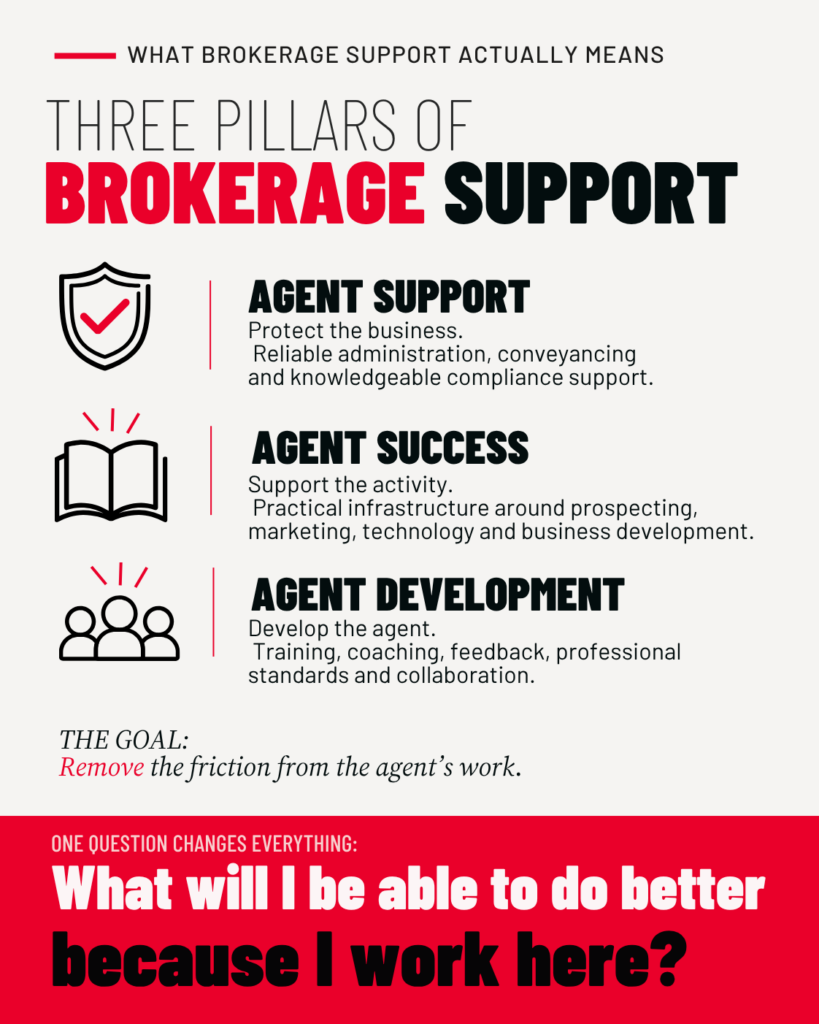
Over time, I’ve come to think about brokerage support in three broad areas:
- Agent Support. Protect the agent’s business, administer transactions properly, collect commissions and provide knowledgeable compliance support.
- Agent Success. Help agents execute the activities that create business, from prospecting and marketing to CRM, technology and listing promotion.
- Agent Development. Help agents become better at the business through training, coaching, feedback, professional standards and collaboration.
Those are also the three pillars we’ve increasingly organized Noralta around.
Underneath all three is one of my mantras as a broker:
Remove the friction from the agent’s work.
The agent is the cyclist. The brokerage is the bike.
I think about brokerage support a little like cycling.
The agent is the cyclist. The brokerage is the bike.
The cyclist has to create the energy. The bike can’t manufacture fitness, determination or effort. In real estate, the agent still has to build relationships, prospect, meet clients, develop their skills and do the work.
But as a cyclist becomes stronger, the equipment underneath them starts to matter.
A good drivetrain transfers energy efficiently. The gears help the cyclist adapt to changing terrain. Good brakes provide the confidence to carry speed. When everything is properly fitted and working together, the cyclist can concentrate on riding instead of fighting the equipment.
That’s how I think about brokerage support.
The brokerage shouldn’t be expected to pedal for the agent. But it should continually look for ways to remove unnecessary friction between the effort an agent puts into their business and the results they’re trying to create.
The three pillars are how we try to do that.
Pillar 1: Agent Support
Before we talk about marketing, coaching, technology or lead generation, a brokerage has a much more fundamental responsibility.
It needs to provide a trustworthy place for an agent to conduct their business.
An agent should be able to count on their contracts with buyers and sellers being properly administered, on commissions being invoiced and collected, and on the brokerage being there when agreements need to be upheld.
Real estate agents also work within a significant regulatory environment. In Alberta, that includes requirements from RECA, the local real estate association, FINTRAC and other rules and regulations that affect how an agent is allowed to practise.
A brokerage should help agents understand those responsibilities and provide somewhere knowledgeable to turn when things get complicated.
That’s important because complicated doesn’t necessarily mean catastrophic.
One holiday season, an agent was working through a challenging negotiation. The other side used a tactic that made the agent question their position, and they needed real-time guidance on how to respond.
The answer was fairly clear once there was someone to talk it through with. The deal came together.
What mattered wasn’t some profound piece of advice.
It was that there was someone genuinely available to give it.
That’s one of the pieces of brokerage support that’s easiest to underestimate during recruiting and hardest to ignore once you actually need it.
Good administration, conveyancing and compliance support remove friction from the mechanics and risk of conducting real estate.
That’s the foundation.
Pillar 2: Agent Success
Once the professional foundation is in place, the next question is: how do we help the agent create and execute more opportunities?
The operational list for an agent can get long very quickly: signs, paperwork, marketing materials, presentations, databases, websites, advertising platforms, content and technology. When the brokerage doesn’t provide something, agents often go outside it to find another coach, another technology provider, another marketing company or another resource.
There’s nothing inherently wrong with doing these things yourself. The question is whether they’re the best use of the agent’s time and energy.
Operational tasks compete for the same attention an agent needs for clients, relationships and business development. A good idea for a prospecting campaign doesn’t create much value if the agent never gets around to executing it.
This is the thinking behind our Agent Success Studio.
The goal isn’t to take ownership of the agent’s business. It’s to provide practical infrastructure that makes business-development and sales activities easier to execute.
That currently includes support around areas such as CRM and database management, content and creative work, photography and media, prospecting, farming, market intelligence and listing promotion.
The specific tools matter less than the principle behind them.
Where is the agent’s time most valuable, and what can we build around them so more of their energy goes there?
If I were designing that support system from scratch, I’d build outward from the work that only the agent can really do.
Help build the call list. Help create the materials. Help organize the systems. Help with the technology. Help prepare the marketing. Help understand the market. Help create opportunities to prospect.
Then let the agent do the part that matters most:
Show up and perform.
Build the relationship. Listen to the client. Ask good questions. Provide advice. Present. Negotiate. Solve problems. Deliver excellent service. Ask for the business.
Those are the places where the agent’s personality, experience, judgment and relationships create the greatest value. A good Agent Success system should be designed to help agents focus more of their effort on exactly that work.
Pillar 3: Agent Development
Not every source of friction can be solved by taking a task off someone’s plate. Sometimes the agent needs to become better at the work.
Knowing the rules isn’t the same as knowing how to run a great real estate practice.
How should you prepare for a listing presentation? What does a good buyer process look like? How do you consistently communicate with a seller? How do you develop a prospecting strategy? What do you do when your business plateaus?
A well-run brokerage can provide proven processes, standard operating procedures, presentations, training, coaching and feedback rather than requiring every agent to figure these things out from scratch.
The agent can still make those tools their own. They should.
The goal isn’t to create a hundred identical REALTORS®. It’s to provide a professional foundation that agents can build on in a way that fits their personality, strengths, clients and ambitions.
This is also where peer support becomes incredibly valuable.
Real estate may be an independent business, but independence doesn’t have to mean isolation. There is real value in working around other professionals who are willing to share an idea, talk through a strategy, make an introduction, offer feedback or simply tell you what’s working for them.
An agent we worked with was spending money on lead sources that weren’t producing the results they wanted. We sat down and looked at their goals and the kind of business they were actually trying to build.
We found a different approach that fit their situation. It created more of the right conversations, and some of those conversations ultimately became transactions.
The change wasn’t complicated. What mattered was taking the time to understand the problem instead of defaulting to a generic answer.
That’s what development and support should do: help the agent become better at making the decisions and doing the work that move their business forward.
Great support usually isn’t a dramatic moment
When people think about broker support, they sometimes imagine the major crisis: a transaction is falling apart and the Broker steps in with the perfect advice that saves the deal.
Those moments happen.
But in my experience, great support is usually much less dramatic. It’s steady, consistent, reliable and positive.
Someone answers the question. Someone says, “Yes, you can do this.” Someone helps organize the next step. A door gets opened. An agent receives a little encouragement at exactly the right moment.
Individually, those moments can seem insignificant. Over time, they build something extremely valuable: confidence.
And confidence changes the way an agent approaches opportunity.
The three pillars should work together
Agent Support, Agent Success, and Agent Development aren’t particularly powerful if they operate as three disconnected departments.
The value comes from having them work together around the agent.
Take something as simple as an agent deciding to build a geographic farming business.
Agent Development can help the agent think through the strategy, identify the kind of client they want to work with and determine whether farming makes sense for their business.
Agent Success can help turn that strategy into action through market intelligence, database support, marketing materials, campaigns and prospecting tools.
When that work creates a client and eventually a transaction, Agent Support provides the infrastructure behind the agreement: compliance, invoicing and collection.
Then the cycle begins again.
Develop the agent. Support the activity. Protect the transaction.
The departments matter, but the agent shouldn’t have to spend their time figuring out how to connect all the pieces.
That’s part of removing the friction too.
Removing friction doesn’t mean removing responsibility
A better bike doesn’t turn someone who refuses to train into a competitive cyclist.
Brokerage support works the same way.
A brokerage can help create a prospecting strategy. It can’t make the agent have the conversation. It can provide a CRM and help organize a database. It can’t build genuine relationships with those people for the agent. It can create marketing materials. It can’t replace the agent’s voice or reputation in the community. It can provide coaching, feedback and accountability. It can’t manufacture ambition.
The cyclist still has to pedal.
Removing friction isn’t about removing responsibility from the agent. It’s about allowing the agent to take greater responsibility for the parts of the business where they create the most value.
Brokerage support should evolve as the agent evolves
Not every agent needs the same thing from each pillar.
A brand-new REALTOR® may lean heavily on Agent Development while learning transactions, developing professional routines and building confidence. An agent a few years into the business may understand the transaction side perfectly well but need more help from Agent Success to develop a reliable source of new clients. A high-producing agent may need leverage: better administration, marketing, technology and systems that protect their time.
That’s why brokerage support shouldn’t be defined by one service or one person. It should be an infrastructure around the agent that they can lean into differently as their business changes.
A simple way to sort out what’s actually included
Before you assume something is covered by a brokerage, sort it into three buckets:
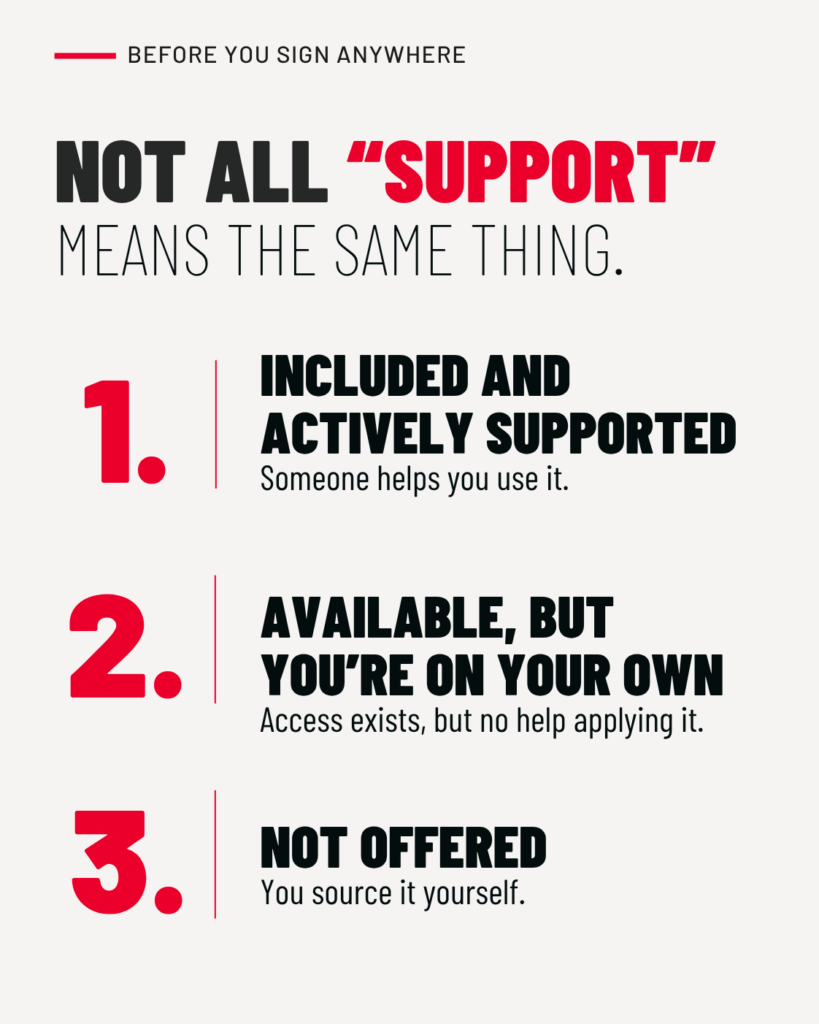
The difference between the first two is easy to miss until after you’ve joined. Having access to something and having support to actually use it are two different things.
So what should your brokerage actually help you with?
For me, it comes back to the three pillars.
- Protect the business. Provide reliable administration and conveyancing, knowledgeable compliance guidance and experienced people to turn to when something gets difficult.
- Support the activity. Help remove the operational friction between an agent having a good idea and actually putting it into market.
- Develop the agent. Provide training, coaching, feedback, professional standards and a collaborative environment that helps the agent continue getting better at their craft.
That doesn’t mean your brokerage should do everything for you. The agent still creates the energy. The brokerage should provide the infrastructure that helps more of that energy reach the road.
So if you’re evaluating a brokerage, don’t just ask: “What do you provide?”
Ask: “What will I be able to do better because I work here?”
That’s a much more useful definition of brokerage support. And it follows directly from the question in the last piece in this series: the best brokerage isn’t necessarily the one with the longest list of services. It’s the one whose support helps you build the business and career you’re actually trying to create.
Where to go from here
The next piece in this series (Coming Soon!) will look at the other side of this question: what it actually looks like when the support isn’t really there, and how to tell the difference between a brokerage that’s genuinely behind you and one that just says it is.

Take the Brokerage Alignment Quiz, or reach out if you’d rather talk through what’s actually available at Noralta. No pressure, no pitch.
Frequently Asked Questions
What does a real estate brokerage do for its agents?
At a basic level, a brokerage provides the professional infrastructure through which agents conduct their business, including transaction administration, commission processing, supervision and compliance support. Depending on the brokerage, support can extend into business development, marketing, technology, training, coaching and other resources.
What kind of support should a REALTOR® expect from a brokerage?
Agents should know who they can turn to for transaction and compliance questions, how reliably their deals are administered, what resources exist to help them develop business and what training and professional support are available. The right balance depends on the agent’s experience, business model and goals.
Should a real estate brokerage provide marketing support?
It can be extremely valuable. Marketing is an area where agents can spend significant time learning tools, creating materials and coordinating campaigns. Brokerage marketing support can help reduce some of that operational friction while allowing the agent to remain responsible for their voice, relationships and business strategy.
Should a brokerage generate leads for its agents?
Agents shouldn’t assume a brokerage will build their business for them. A brokerage can support prospecting and sales development through strategy, systems, technology, coaching, marketing and opportunities, but agents still need to build relationships, follow up and convert opportunities into clients.
What shouldn’t I expect a brokerage to do for me?
Build your business for you. A brokerage can provide infrastructure, support and systems, but the effort and follow-through still belong to the agent. The brokerage’s job is to remove friction from the work, not replace the work itself.
How do I compare brokerage support in Edmonton, Spruce Grove, Sherwood Park or Fort Saskatchewan?
Look beyond whether a brokerage says it provides “support.” Ask specifically about the three pillars: how your transactions and compliance are supported, what resources exist to help you create business, and how the brokerage helps you continue developing as a professional.
How do I find out what’s actually included versus just available?
“Included and actively supported” and “available but on your own” can look very similar on a recruiting presentation but feel very different once you’re running your business. Ask specifically whether someone helps you use each service or whether you’re simply given access and expected to figure it out.
What is a real estate Broker responsible for in Alberta?
In Alberta, the Broker is responsible for managing the brokerage and maintaining appropriate supervision, policies and procedures so the brokerage operates competently and in accordance with applicable rules. Individual agents still have their own professional responsibilities, but brokerage oversight is an important part of the regulatory structure under the Real Estate Council of Alberta.