

Working with a REALTOR® in Edmonton: Understanding Agency in Alberta
Buying or selling a home in Edmonton is one of the biggest financial decisions you’ll ever make, and the relationship you choose with your real estate brokerage shapes every part of that process. The terms, sole agency, transaction brokerage, and customer status, can sound like legal jargon, but they have real, practical consequences for how hard your REALTOR® can negotiate on your behalf, what they’re allowed to tell you, and what they have to keep confidential.
This guide explains how agency relationships work in Alberta, what your REALTOR® owes you, what you owe them in return, and how we approach it in practice at Royal LePage Noralta. We’ve helped buyers and sellers across Edmonton, Sherwood Park, Stony Plain, Spruce Grove, and Fort Saskatchewan since 1999, so the examples here come from how this actually plays out in our market: not just what the regulations say.
After 25 years in this market, the deals that go sideways usually have one thing in common: someone didn’t fully understand the relationship they were in. A buyer who thinks their agent is fighting for them, when that agent is actually facilitating for both sides, is at a real disadvantage. We make it a priority to have that conversation early, before anyone falls in love with a property. – Tom Shearer
How to Choose a REALTOR® in Edmonton
Before you sign anything, take the time to pick the right person. A few things to look for:
- Local market knowledge. Edmonton’s neighbourhoods vary widely: Riverbend, Mill Woods, Glenora, and Summerside all behave differently in terms of pricing, inventory, and buyer demand. Your REALTOR® should know the area you’re focused on, not just the city at a high level.
- The right fit for your transaction. Some agents specialize in listings, others in buyers, and some in specific property types like acreages, infills, or luxury homes. Ask what they handle most, and whether that lines up with what you need.
- Transparent fees and contract terms. Commission structures, service inclusions, and cancellation terms differ between brokerages. Ask for everything in writing and read it carefully before you sign.
- References and track record. Ask to speak to recent clients or look at verified reviews. Years in the business matter, but so does how they communicate and follow through.
Questions worth asking on the first call:
- How long have you worked in the Edmonton market?
- What communities do you know best?
- How will you communicate with me, and how often?
- What’s included in your fee, and what isn’t?
- What happens if I’m not satisfied and want to cancel?
Royal LePage Noralta has operated from the same Edmonton-area roots since 1999, which means our agents aren’t rotating through a franchise. They know these communities because they live and work in them. Our team of 176 REALTORS® works across four offices in Edmonton, Sherwood Park, Fort Saskatchewan, and Spruce Grove/Stony Plain, and newer agents work alongside experienced mentors so that every client gets the benefit of that accumulated local knowledge, not just whoever happens to pick up the phone.
We were named A.E. LePage Brokerage of the Year for the Prairies Region in 2024, which reflects the standard we hold ourselves to. We’re also proud supporters of the Royal LePage Shelter Foundation, which means a portion of every transaction contributes to funding women’s shelters and violence prevention programs across Canada. When you work with a Noralta REALTOR®, you’re working with someone who is invested in this community in more ways than one.
What Is a Real Estate Agency Relationship?
An agency relationship is formed when two parties agree that one will represent the other, or provide services on their behalf. Until you actually sign a service agreement, there’s no agency relationship. Talking to a REALTOR® about a home or getting their thoughts on your market doesn’t lock you into anything.
Once you’re ready to be represented, the brokerage will ask you to sign a written service agreement. You aren’t required to sign one, but these agreements protect both sides. They spell out:
- The nature of the relationship
- The duties each party owes
- The scope of services being provided
- The fees involved
- What happens if either side wants to end the agreement
In Alberta, agency relationships are regulated by the Real Estate Council of Alberta (RECA), and every licensed brokerage must comply with its rules.
Your REALTOR®’s Responsibilities to You
Once you’ve entered an agency relationship, your REALTOR® has legal duties to protect and advance your interests. Specifically, they owe you:
Undivided Loyalty
Your REALTOR® works for you, and only you. Your interests come ahead of theirs, and ahead of anyone else’s in the transaction.
What it looks like in practice: If two buyers your REALTOR® represents are both interested in the same home, that’s a conflict, and they have to tell you, not quietly play both sides to close a deal faster. If the listing agent is a family member or a close colleague, you hear about it.
Confidentiality
Anything you share that isn’t legally required to be disclosed stays confidential: your motivations, your top price, your personal circumstances. This duty continues even after the transaction ends.
What it looks like in practice: You can tell your REALTOR® you’re motivated to move quickly because of a job start date, or that you’d be willing to go $20,000 over asking if you really had to. That information never leaves the room.
Full Disclosure
Your REALTOR® has to tell you anything they know that could affect your decision or the transaction, including any conflict of interest on their end. They don’t get to decide what’s important to you.
What it looks like in practice: If there’s a prior insurance claim on a property they’re aware of, you hear about it. If the listing agent is their sibling, you hear about it. If a competing offer is coming in Tuesday, you hear about that too.
Obedience
Your REALTOR® follows your lawful, reasonable instructions. They can advise you, but the decisions are yours to make.
What it looks like in practice: You set the pace. You decide what offers to write, at what price, with what conditions. If you want to wait a week before moving on a home, they wait. If you want to write an offer tonight, they write it tonight.
Reasonable Care and Skill
Your REALTOR® is expected to do the job to the standard of a competent, experienced industry professional.
What it looks like in practice: They should catch obvious red flags in a listing, understand the Seller’s Property Disclosure, negotiate effectively, meet deadlines, and recognize when something is outside their expertise and needs a specialist referral.
Full Accounting
Any money or property handed to your REALTOR® on your behalf must be tracked and accounted for.
What it looks like in practice: Deposits and earnest money are held in trust, documented, and reconciled in writing. You should never be guessing where your deposit is.
Your Responsibilities as the Client
You also have obligations to your REALTOR® under an agency relationship, including:
- Compensating your REALTOR® for expenses incurred on your behalf
- Paying any agreed-upon fee outlined in a signed service agreement
- Disclosing matters that could affect the transaction, including material facts that must be passed on to the other party
Sellers in particular are required by law to disclose known material latent defects, structural or health-related defects that can’t be detected by a visual inspection. A leaky basement that’s been patched over. Known issues with the foundation. Mould behind the drywall. If you know and don’t disclose, the legal risk lands on you, not your REALTOR®.
It’s also your responsibility to read every document carefully and understand what you’re signing. If you need help, you always have the option to consult a lawyer, accountant, or home inspector.
Work With a Real Estate Agency You Can Trust!
Types of Agency Relationships in Alberta
There are two main forms of agency representation in a typical Alberta real estate transaction, plus one non-agency option.
| Sole Agency | Transaction Brokerage | Customer Status | |
|---|---|---|---|
| Who the brokerage works for | You only | Both parties, neutrally | Neither: no agency |
| Duties owed to you | All six full agency duties | Honesty, fairness, skill: but no advocacy | Honesty, reasonable care, no misleading information |
| When it typically happens | The default when you choose a brokerage to represent you | When one brokerage ends up representing both buyer and seller on the same deal | When you decline agency, or a conflict of interest prevents full representation |
| What you give up | Nothing: you have full representation | Confidentiality limits and no advocacy on price or motivation | Advice, advocacy, and negotiation support |
| When it's usually the right fit | Most buyers and sellers | When you've found the home you want and it's already listed with the same brokerage representing you | When you prefer to self-direct but still need help with forms and paperwork |
Sole Agency
Sole agency happens when one brokerage (including its broker, associate brokers, and associates) represents the seller, and a different brokerage represents the buyer. Each party has their own dedicated representation and the full agency duties that come with it.

Figure 1. A Brokerage to a Realtor, to a buyer or seller.
Transaction Brokerage
A potential conflict of interest arises when a single brokerage represents both the buyer and the seller in one transaction. For example, if you want to make an offer on a home listed by the same brokerage that represents you: or if another buyer represented by your brokerage wants to make an offer on your home: that’s a conflict.
In those situations, a different relationship called transaction brokerage can be formed. It applies whether one REALTOR® represents both parties, or two different REALTORS® within the same brokerage each represent a party.
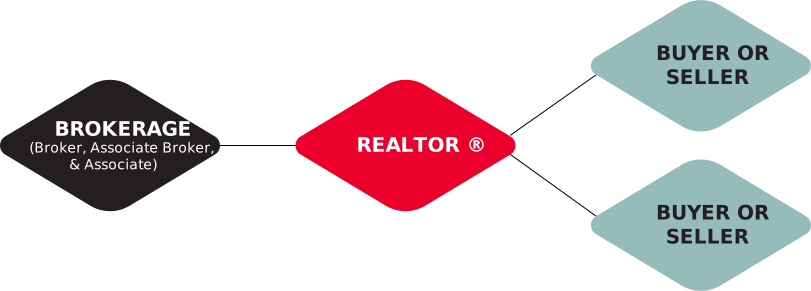
Figure 2. Brokerage (a Realtor), to a REALTOR®, to two different buyers or sellers.
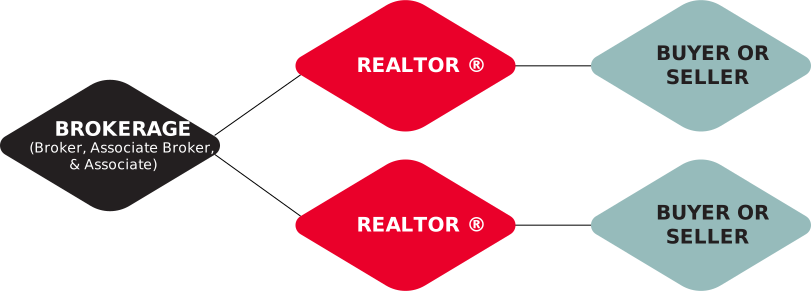
Figure 3. Brokerage to two REALTOR®s, to two different buyers or sellers.
Transaction brokerage is only allowed with the fully informed, voluntary consent of both buyer and seller. That consent is captured in a Common Law Transaction Brokerage Agreement, signed by the buyer before an offer is made and by the seller before the offer is presented. Under this agreement, the brokerage acts as a Transaction Facilitator, helping both parties reach a mutually acceptable deal.
The Transaction Facilitator treats both sides even-handedly and impartially, and any advice or information shared with one party must be shared with the other. However, the Transaction Facilitator cannot disclose:
- That the buyer may be prepared to offer a higher price or agree to different terms
- That the seller may be prepared to accept a lower price or agree to different terms
- The motivations of either party
- Personal information about either party
Customer Status (Non-Agency)
If you’d rather not enter an agency relationship but still want to work with a brokerage, you can choose customer status. In this arrangement, the brokerage is not your agent and does not owe you agency duties. What they do owe you is honesty, reasonable care and skill, and the obligation not to provide false or misleading information, whether knowingly or through negligence.
Under customer status, the brokerage can supply forms and perform services to help you complete a transaction, but they won’t advise you or advocate on your behalf.
A brokerage might recommend customer status when a conflict of interest would otherwise limit their ability to serve you fully. For example, if the brokerage already represents a seller with whom it has a long-standing relationship (like a developer or a family member of a brokerage representative), you as a buyer may be asked to accept customer status.
If a brokerage recommends customer status and you’d prefer full agency representation, you’re always free to work with a different brokerage.
Which Relationship Is Right for You?
Most Edmonton buyers and sellers fall into one of three situations. Use this as a starting point and talk it through with your REALTOR®:
- “I want a REALTOR® working exclusively in my interests from search to close.” → Sole agency. This is the default for most transactions.
- “I’m working with a brokerage, and I’ve found a home that’s listed by that same brokerage.” → Transaction brokerage. You’ll need to give informed consent in writing before an offer is made.
- “I want help with paperwork and forms, but I’m handling my own negotiation and strategy.” → Customer status. Less common, but available if you want it.
Your REALTOR® is required to walk you through these options before you sign anything. If they skip the conversation, ask for it.
What to Prepare Before Meeting with a REALTOR®
A little prep work makes the first meeting far more productive. Before you sit down with an Edmonton REALTOR®, have the following ready:
- Your budget and financing. A mortgage pre-approval from your lender or broker tells everyone what’s actually achievable. If you don’t have one yet, our getting preapproved guide walks through the process.
- Your must-haves and nice-to-haves. Separate the non-negotiables (number of bedrooms, school catchment, commute) from the flexible items. This helps your REALTOR® shortlist properties quickly.
- Your timeline. Are you moving in 30 days, six months, or just starting to look? This shapes the entire strategy.
- Your preferred communication style. Text, email, phone, weekly check-ins: let your REALTOR® know up front.
- Questions about the contract. Read any service agreement before you sign, and ask about fees, scope, and cancellation terms.
Our first-time home buyer’s guide covers this in more depth if you’re newer to the process.
Common Mistakes We See Buyers Make
- Buyers assuming the agent at an open house represents them (it’s usually the listing agent’s brokerage)
- Sellers not realizing their latent defect disclosure obligations until they’re mid-transaction.
- Signing a buyer service agreement without asking what happens if they want to end it
- Assuming a REALTOR® they met at an open house “represents” them (they usually represent the seller)
- Not realizing transaction brokerage changes what their REALTOR® can tell them
- Waiving the agency conversation because it feels like paperwork
- Hiring a friend or family member as their REALTOR® without thinking through the dynamic
Making an Informed Choice
Your REALTOR® is responsible for walking you through your relationship options. Make sure you understand the duties you’re owed, the limits of each arrangement, and any conditions specific to your transaction. Don’t hesitate to ask questions until you feel confident in the answer.
A note on federal requirements: Under the Proceeds of Crime (Money Laundering) and Terrorist Financing Act (PCMLTFA), real estate professionals are required to collect personal information to identify individuals involved in large financial transactions. A note on federal requirements: your REALTOR® is required to verify your identity under federal legislation. Your agent can walk you through the details, or visit the FINTRAC website for more information.
Frequently Asked Questions
In most cases, no. The seller’s brokerage typically offers a co-operating commission that covers the buyer’s agent’s fee. Your service agreement will spell out the specifics: read it carefully and ask if anything’s unclear.
No. You’re free to decline a written service agreement, but signing one gives you and the brokerage clarity on the scope of the relationship, the duties owed, and any fees involved. Most buyers and sellers find the protection worth it.
Under sole agency, each party has their own dedicated brokerage with full agency duties. Under transaction brokerage, a single brokerage represents both parties in the same transaction and acts as a neutral facilitator, with limits on what can be disclosed to each side.
A listing agent represents the seller. A buyer’s agent represents you. In a sole agency arrangement, these are two different people from two different brokerages. In a transaction brokerage situation, it might be two agents from the same brokerage acting as facilitators, or even one agent acting as a neutral facilitator for both parties.
It depends on whether you’ve signed a service agreement. If you have an exclusive buyer representation agreement with one brokerage, you’re generally committed to working through them for the duration of that agreement. Read your agreement before signing and ask about the exclusivity terms.
Yes, but the terms depend on your signed service agreement. Review the cancellation terms before you sign, and talk to the brokerage if you have concerns before assuming you’re locked in.
It can be the right choice in specific situations, usually when a conflict of interest would limit a brokerage’s ability to represent you fully. In most cases, though, buyers and sellers benefit more from full agency representation.
Under federal legislation, the Proceeds of Crime (Money Laundering) and Terrorist Financing Act (PCMLTFA): real estate brokers are required to verify the identity of clients involved in large financial transactions, including buying or selling property. This is a legal requirement, not something specific to Royal LePage Noralta. You can learn more at the FINTRAC website.
At minimum: how long they’ve worked in the Edmonton market, which communities they know best, how they prefer to communicate, what’s included in their fee, and what happens if you want to end the contract.
Not necessarily. It means neither side gets someone actively pushing for the absolute best price or terms on their behalf: the brokerage is facilitating, not advocating. Some buyers and sellers are comfortable with that trade-off when they’ve found exactly the home or buyer they want. Others prefer to keep things in sole agency by working with a different brokerage.
Have Questions About Working With a Real Estate Agency?
Our real estate team is happily standing by to help provide you with the answers you need to feel confident in the home buying process.